Published by Yala Media Group | April 2026
The wedding ring question comes up at nearly every Muslim wedding discussion, and it sits at the intersection of Islamic jurisprudence, cultural practice, and the practical reality that most Muslim men in the West are marrying in environments where ring-wearing is the norm. The question deserves a thorough, honest answer — because a casual “it’s fine” or a reflexive “it’s haram” both miss the genuine nuance in the scholarly discussion.
The actual picture: a Muslim man can wear a wedding ring, with important conditions. The most critical condition is not the one most people expect.
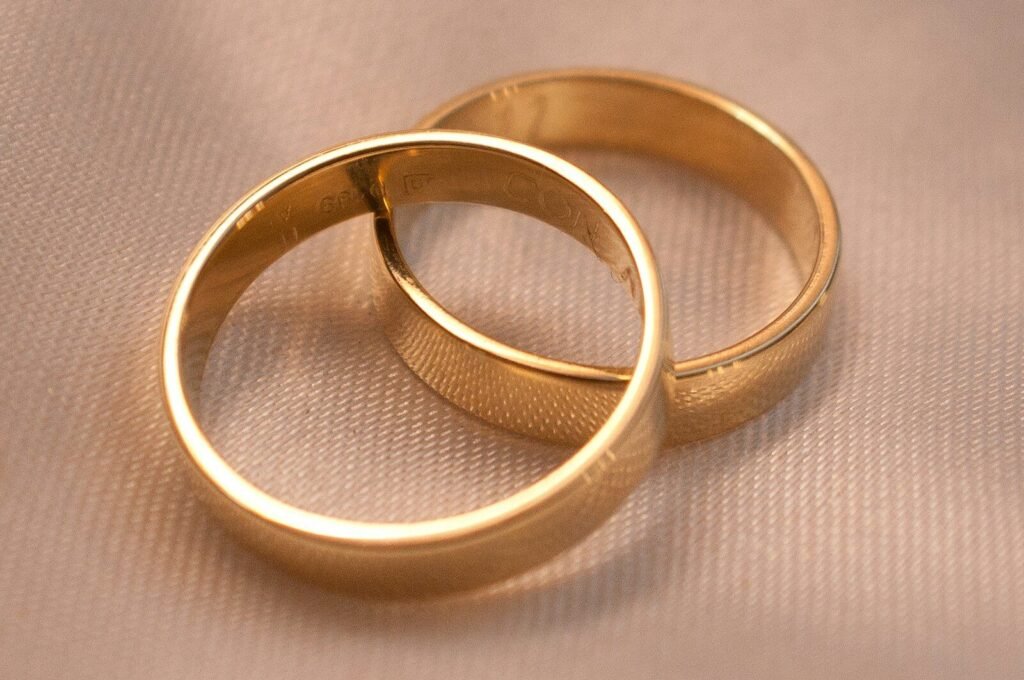
The single clearest ruling: no gold for men
Before anything else about wedding rings, one ruling is unanimous across all four madhabs and backed by multiple authentic hadith: Muslim men may not wear gold.
The Prophet ﷺ forbade gold for the males of his ummah. When he saw a man wearing a gold ring, he took it from the man’s hand and threw it away, saying: “Would any one of you take a coal from the fire and hold it in his hand?” — Sahih Muslim.
In another narration: “Wearing gold is forbidden for male Muslims, but it is allowed for female Muslims.” — Tirmidhi.
This prohibition is among the most agreed-upon rulings in Islamic jurisprudence. Islamic scholars across different schools of thought agree on this rule, making it among the few unanimous prohibitions regarding appearance. A Muslim man who wants to wear a wedding ring must choose a material other than gold — no exceptions, regardless of cultural expectation or social pressure.
Permissible materials for men:
- Silver — the most clearly established permissible material. The Prophet ﷺ himself wore a silver ring, and silver rings for men are well-supported by authentic practice.
- Platinum — generally considered permissible by contemporary scholars, though some advise caution given that it is sometimes described as a white-gold alternative.
- Titanium, tungsten, stainless steel — permissible by the scholarly consensus that anything not specifically prohibited and not resembling gold is allowed.
The prohibition on gold for men is the non-negotiable. Everything else in this article operates within that boundary.
Is wearing a wedding ring an innovation (bid’ah)?
Some scholars raise a more fundamental objection: the wedding ring is not part of Islamic tradition at all. It originated in ancient pagan and later Christian customs — the ring as a symbol of marital commitment does not appear in the Quran, the hadith, or the practice of the Prophet ﷺ and his companions. Neither the Prophet ﷺ nor his companions exchanged or wore rings specifically to signify marriage.
This is historically accurate. The wedding ring as a marital symbol pre-dates Islam by thousands of years and was associated with Greek, Roman, and Christian practices. Muslims adopted it from non-Muslim cultures.
The scholarly question is whether this makes it impermissible. The relevant principle: imitating non-Muslims is forbidden when it concerns practices specific to their religious identity. However, practices that have become universal cultural norms — carried by both Muslims and non-Muslims — without inherent religious meaning are generally permissible.
Sheikh Assim Al Hakeem puts it this way: wearing a ring as a cultural symbol differs fundamentally from believing it creates or strengthens marital bonds. The former is permissible; the latter approaches shirk.
IslamOnline’s Fatwa Committee states: wearing an engagement or wedding ring is not considered unlawful in the Islamic perspective, as there is no religious text that determines this. It is also not considered as a form of imitating unbelievers, since the practice has become common among both Muslims and non-Muslims.
The Hadith of the Day platform similarly notes: matters which are not specific to non-Muslim religious practices — like birthdays, or clothing not representative of a religious symbol — do not fall within the category of forbidden imitation, as long as they don’t affect one’s belief and are not done out of a desire to be like non-Muslims in something Islam does not approve of.
The scholarly conclusion on this point: wearing a wedding ring as a cultural symbol of marital commitment, without any religious significance attached to it, is permissible according to the majority of contemporary scholars. Some conservative scholars advise against it as unnecessary imitation of non-Muslim customs. Both positions have legitimate scholarly grounding.
The shirk concern — the most important condition
The condition that many scholars emphasize most strongly is the one that gets overlooked in the ring debate: the wedding ring becomes haram if it is associated with any belief about its power.
Specifically:
- Believing that wearing the ring strengthens or protects the marital relationship
- Believing that removing the ring has a negative effect on the marriage
- Considering removing it to be a bad omen
- Engraving names on the ring with the belief that this creates a bond between the couple
The Muslim man who wears a wedding ring as a cultural symbol — the same way he might wear a watch or a certain type of clothing as a social norm — without any belief about its spiritual or relational power, is in permissible territory. The Muslim man who removes his ring reluctantly because he fears it will harm his marriage, or who believes the ring is doing something for his relationship, has crossed into problematic territory.
This is not a minor concern. It is the most significant Islamic objection to wedding rings in practice, and it applies to both men and women.

Which finger and which hand?
The Prophet ﷺ gave guidance on ring-wearing for men:
Finger: Men should not wear rings on the index or middle finger. The Prophet ﷺ specifically forbade this for Ali (RA). The little finger (pinky) is the most recommended finger for men, with the ring finger also generally permitted. Some scholars say thumb rings are acceptable.
Hand: There is scholarly disagreement:
- The Hanafi, Maliki, and Hanbali schools generally recommend the left hand for men
- The Shafi’i school prefers the right hand
The Prophet ﷺ himself is reported to have worn his ring on different hands at different times, which accounts for some of the scholarly disagreement. Either hand is permissible according to some scholarly position.
Summary: the practical guide for Muslim men
Can a Muslim man wear a wedding ring? Yes, with the following conditions:
- Not gold — this is the absolute rule. Silver, platinum, titanium, stainless steel, tungsten are all permissible materials.
- No belief in its power — wear it as a cultural symbol, not as something that protects or strengthens the marriage. The marriage is protected by tawakkul in Allah, taqwa, and righteous conduct — not jewelry.
- No engraving intended as a bond — simple decorative engraving is fine; engraving names or symbols with the belief that they create or strengthen marital bonds is not.
- Correct finger — not the index or middle finger. The little finger is most recommended.
- Intention matters — wearing the ring because your wife appreciates it, because it’s a cultural norm in your community, or simply because you like it, is fine. Wearing it to show off is not.
A Muslim man who wears a simple silver band on his pinky finger as a cultural acknowledgment of his marriage, without any belief about what the ring does for his marriage, is on clear scholarly ground. The Prophet ﷺ himself wore a silver ring — not as a wedding ring, but as an example that men and rings are not incompatible in Islam.
The gold ban is the rule. Everything else is nuance.
Yala Media Group builds technology for the Muslim community where giving is structural, transparent, and effortless. Learn more at yalamediagroup.com.