Published by Yala Media Group | April 2026
The halal food landscape in America has changed fundamentally. In 2026, the halal food industry in the United States is not rising. It has arrived — quietly, without asking permission. Over 13,000 halal restaurants now operate across the country, and the halal food market has reached $25.9 billion annually, with projections that dwarf what anyone imagined two decades ago when halal dining meant finding the one Pakistani restaurant in a twenty-mile radius.
What has changed is not just quantity but character. Halal food in America’s best cities now means Pakistani barbecue that smokes meat for twelve hours, Palestinian mezze that rivals anything in Ramallah, Somali canjeero served alongside shaah cadees at six in the morning, Indonesian Muslim cafés where the menu is in three scripts, Korean barbecue done zabiha, Senegalese thiéboudienne that would make a Dakar grandmother nod. The diaspora has cooked itself into American cities in a way that is irreversible and extraordinary.
This guide evaluates American cities by the depth, diversity, authenticity, and accessibility of their halal food scenes — not just whether halal food exists, but whether the halal food is genuinely excellent and worth traveling for.
1. New York City / New Jersey Metro — The Unmatched Standard
New York remains the undisputed capital of halal food in America. Not because it has the highest concentration of halal restaurants per capita — it doesn’t — but because the sheer scale and diversity of what is available is simply impossible to match anywhere else.
On a single stretch of Roosevelt Avenue in Jackson Heights, Queens, you can pass Bengali rice houses, Pakistani curry counters, Afghan bakeries, Nepali momo stalls, Uzbek grills, and South Indian Muslim cafés — each calibrated to a clientele that knows exactly what it wants and what it should cost. This is where some of America’s most extraordinary halal food exists on the tightest budgets, in the most unpretentious settings, served by people who learned these recipes in the countries where they originated.
Manhattan’s halal food cart culture — anchored by The Halal Guys, who started as a single cart near 53rd and Sixth Avenue and became an institution — introduced millions of non-Muslim Americans to halal food through the most democratic format imaginable: six dollars for chicken and rice over white sauce on a street corner at midnight. The model has been replicated endlessly and the original is still worth the line.
In Brooklyn, Bay Ridge remains the center of Arab-Muslim culinary life — Lebanese pastry shops, Palestinian bakeries, Yemeni restaurants, and Egyptian cafés running for blocks along Fifth and Fourth Avenues. In the Bronx, West African halal restaurants serve peanut stew and jollof rice to communities from Senegal, Guinea, and Mali.
Across the Hudson, New Jersey adds another dimension. Paterson’s Arab and South Asian halal restaurants serve food that is unpretentious and deeply satisfying, at prices that remain reasonable and portions that remain generous. Jersey City’s South Asian community has produced a halal restaurant corridor that rivals anything in Edison or Iselin. Patterson, Clifton, and Passaic collectively constitute a halal food landscape of extraordinary depth.
Best for: Breadth and diversity. If you want to eat halal food from fifteen different countries in a single weekend without leaving the metro area, no other city makes this possible.
Signature finds: Halal Guys (Manhattan), Jackson Heights (Queens), Bay Ridge (Brooklyn), Roosevelt Avenue (Queens), Paterson (NJ).
2. Dearborn, Michigan — The Emotional Center
Dearborn remains the emotional center of halal food in America — not because it is flashy, but because it is certain. This is halal food that has been doing the same thing, at the same standard, for decades — and the standard is high.
The Lebanese, Iraqi, Yemeni, and Palestinian communities of Dearborn have created a culinary environment that is simultaneously the most Arab-American city in America and one of its most authentic Middle Eastern food destinations. Restaurants here are not serving adapted versions of the cuisine — they are serving the cuisine, made by people who brought the recipes with them and have maintained them with the stubbornness of people who know what it’s supposed to taste like.
Yemeni breakfast — malawah flatbreads with honey and hulba, saltah with rice and lamb — is some of the most distinctive and least-known Muslim cuisine in America, and Dearborn serves it daily. Iraqi restaurants serve masgouf fish, kubba dishes, and tashreeb in ways that simply do not exist outside of Iraqi immigrant communities. Lebanese shawarma, fattoush, and knafeh made by Lebanse hands for Lebanese customers sets a standard that most of America’s Lebanese-adjacent restaurants cannot approach.
The Michigan Halal market has also produced one of the most complete halal grocery ecosystems in the country — every major grocery store in Dearborn stocks halal meat, and specialty stores carry ingredients from across the Arab world that are unavailable in most American cities.
Best for: Authenticity and depth in Arab cuisine. The most comprehensive Arab-Muslim food environment outside the Arab world.
Signature finds: Yemeni breakfast restaurants, Iraqi masgouf, Lebanese pastry shops, Palestinian bakeries.

3. Chicago — Reliability and Range
Chicago’s halal food culture prizes reliability. Along Devon Avenue — Chicago’s legendary South Asian commercial corridor — Pakistani and Indian Muslim restaurants continue to do what they have always done: grill carefully, spice deliberately, and feed generously. The kebabs on Devon are excellent because they have been made the same way for decades.
Devon Avenue alone constitutes a complete halal food education. Pakistani restaurants serve nihari on Sundays with the same devotion they bring to Friday prayers. Biryani spots debate their rice recipes with the seriousness of fiqh scholars. Halal Chinese, halal Mexican, halal soul food — Chicago’s diversity has produced halal cross-cultural cooking that is adventurous without being gimmicky.
Beyond Devon, the Bridgeview and Orland Park suburbs have developed a comprehensive Arab Muslim restaurant and grocery corridor that serves the large Palestinian, Jordanian, and Lebanese communities concentrated in Chicago’s southwestern suburbs. Bosnian and Middle Eastern restaurants in the northwestern suburbs add depth, offering breads, stews, and roasts that emphasize comfort over spectacle.
The Chicago Muslim Halal Festival draws thousands annually, boosting the local halal food economy and connecting Muslim food entrepreneurs with a broader audience.
Best for: South Asian Muslim cuisine. Devon Avenue is one of the great Muslim food streets in America.
Signature finds: Devon Avenue Pakistani restaurants, Sunday nihari, Bridgeview Arab food corridor.
4. Houston — Expansive, Ambitious, Diverse
Houston’s halal scene mirrors the city itself — expansive, ambitious, and unafraid of scale. Pakistani barbecue joints smoke meat for hours. Somali cafés serve rice dishes meant to feed entire families. Pakistani sweet shops sell mithai in varieties that would take a week to work through. Nigerian Muslim restaurants serve jollof and pepper soup to communities from Lagos and Ibadan.
Houston’s halal food diversity reflects the city’s status as one of the most ethnically diverse major cities in America. The Muslim community here draws from South Asia, the Arab world, West Africa, East Africa, Southeast Asia, and the American South — and the food reflects all of it. A Muslim food tourist in Houston can eat Bangladeshi biryani for lunch, Somali suqaar for dinner, and Pakistani chai for dessert without driving more than thirty minutes in any direction.
The Hillcroft Avenue corridor — sometimes called the “International Corridor” — is Houston’s equivalent of Devon Avenue: a dense concentration of South Asian and Middle Eastern halal restaurants, grocery stores, sweet shops, and bakeries that functions as the commercial heart of Houston’s Muslim community.
Best for: Scale and diversity of halal food cultures. Particularly strong for South Asian, Somali, and West African Muslim cuisine.
Signature finds: Hillcroft Avenue corridor, Pakistani barbecue, Somali restaurants, Nigerian Muslim food.
5. Los Angeles — Fusion, Creativity, and Scale
Los Angeles represents halal food as adaptation — shaped by migration, creativity, and choice. Persian kebab houses coexist with Palestinian bakeries, Indonesian Muslim cafés, and halal Korean barbecue experiments. The city’s sprawl prevents concentration, but rewards exploration.
The Iranian Muslim community in Los Angeles — one of the largest outside Iran — has created a Persian restaurant scene that is genuinely world-class. Koobideh, joojeh, and ghormeh sabzi prepared by Iranian families who have been doing this for decades produce the authentic Persian culinary experience that few American cities can access.
Irvine and Anaheim in Orange County have developed dense Arab and South Asian Muslim communities whose halal restaurant scenes are increasingly sophisticated. Halal Mediterranean fast-casual, halal Korean barbecue, halal sushi — Los Angeles is where halal food meets American culinary innovation most directly.
The Southeast Asian Muslim community in LA — particularly Malaysian and Indonesian Muslims — has also produced some of the city’s most underappreciated halal food: nasi lemak, rendang, satay, and laksa in restaurants that serve a community who knows what they’re supposed to taste like.
Best for: Innovation and fusion. Particularly strong for Persian, Arab, and Southeast Asian Muslim cuisine.
Signature finds: Persian restaurants in Westwood/Tehrangeles, Orange County Arab food corridor, Indonesian and Malaysian Muslim restaurants.

6. Dallas-Fort Worth — The Rising Standard
In the suburbs of Irving, Dallas has developed one of the country’s most robust halal food corridors. Pakistani, Afghan, and Arab restaurants cater to families rather than trends. This is halal food meant to be shared, taken home, eaten again the next day.
DFW’s halal food scene has grown dramatically alongside the region’s Muslim population — one of the fastest-growing in the country. The Las Colinas and Irving areas have become particularly dense with South Asian and Arab halal restaurants, with the Richardson and Plano suburbs adding significant depth to the North Dallas corridor.
Texas barbecue — adapted for halal — is one of the most authentically American halal food innovations in the country. Several DFW restaurants now offer fully zabiha-certified brisket, pulled beef, and smoked ribs that satisfy both the Islamic requirement and the Texas standard for barbecue quality. This is not a compromise — the best halal Texas barbecue in DFW is genuinely competitive with the conventional offerings.
Best for: Family dining and South Asian Muslim cuisine. The best halal Texas barbecue in the country.
Signature finds: Irving/Las Colinas South Asian corridor, halal Texas barbecue, Plano North Dallas restaurant cluster.
7. Washington D.C. Metro — Educated Palates and Diplomatic Roots
The D.C. metro area’s halal food scene reflects its Muslim community — highly educated, internationally connected, ethnically diverse, and with high standards. The diplomatic community has historically provided a customer base that demands authentic representation of their home countries’ cuisines, which has raised the quality ceiling across the region.
Northern Virginia — particularly the communities around Herndon, Sterling, and Falls Church — has a dense concentration of South Asian, Arab, and Afghan Muslim restaurants that serve a professional Muslim clientele with sophisticated palates and the disposable income to support quality. Afghan cuisine in particular is a Northern Virginia strength — Washington’s large Afghan refugee and immigrant community has produced some of the best Afghan food in America, including qabuli palaw, mantu, and bolani that are simply not available at this level in most American cities.
Maryland’s Prince George’s County — home to the Diyanet Center of America — has a growing African Muslim food scene that reflects the region’s large Ethiopian and Eritrean communities.
Best for: Afghan cuisine, diplomatic-quality Arab food, South Asian Muslim fine dining. Particularly good for Muslim food tourists with high standards and the budget to match.
Signature finds: Northern Virginia Afghan restaurants, Falls Church Afghan strip, South Asian Muslim restaurants in Herndon and Sterling.
8. Atlanta, Georgia — Unfinished in the Best Way
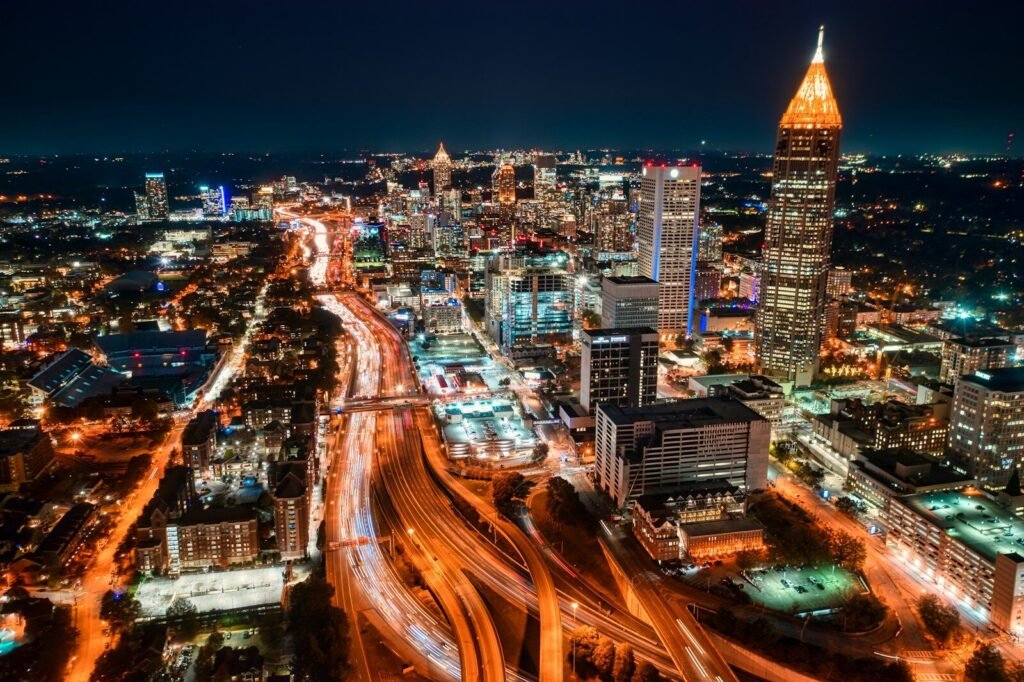
Along Buford Highway, Atlanta’s halal kitchens reflect the city’s growing Muslim diversity. Middle Eastern, South Asian, and East African restaurants sit side by side, experimenting while remaining accessible. Atlanta’s halal food scene in 2026 feels unfinished — in the best possible way.
Buford Highway is one of the great ethnic food corridors in America — an eight-mile stretch of international restaurants that includes some of the most authentic and least pretentious halal food in the South. Somali restaurants in Clarkston, Halal Chinese in Doraville, Pakistani restaurants in Duluth, and West African food along Buford Highway proper create a halal food tour that rewards adventurous eating.
The Perimeter Center and Dunwoody corridor — where Muslim professional families have concentrated over the past decade — has produced a growing suburban halal restaurant scene. Upscale halal Mediterranean, halal brunch, and halal fusion restaurants are increasingly appearing in the northern suburbs to serve a Muslim professional demographic with high expectations.
Full disclosure: Yala Media Group is based in Atlanta, and our co-founder Ahmad runs Yaba’s Bagels — a halal New York-style bagel shop in Dunwoody — so we have personal perspective on the Atlanta halal food scene.
Best for: Diversity and discovery. The best halal food in the South and one of the most underrated halal food cities in America.
Signature finds: Buford Highway International corridor, Clarkston East African restaurants, Dunwoody growing Muslim food scene.
How to find halal food wherever you are
Zabihah.com — the most comprehensive halal restaurant directory in America, with user reviews and certification information. Search by city or zip code before traveling.
The Halal Times app — curates halal food news, restaurant spotlights, and city guides with editorial perspective.
HalalTrip — particularly useful for Muslim travelers, with halal restaurant guides organized by city and country.
Instagram and TikTok — Muslim food influencers in every major city create content specifically about local halal dining. Search your city name plus “halal food” and you’ll find local knowledge that no directory can match.
Your local masjid — ask after Jumu’ah. The community knows where to eat, what has gotten better, what has closed, and which spots are genuinely zabiha versus just claiming to be.
Yala Media Group builds technology for the Muslim community where giving is structural, transparent, and effortless. Learn more at yalamediagroup.com.