Published by Yala Media Group | April 2026
There is a moment that most Muslims know intimately, even if they have never named it. Something happens — a door closes, a loss arrives, a plan falls apart, a relationship ends, a health diagnosis comes, a job doesn’t work out — and somewhere beneath the inna lillahi you say with your mouth, there is a part of you that is screaming why.
Not why in the curious sense. Why in the wounded sense. Why me. Why this. Why now. Why when I was trying so hard. Why when I was making dua. Why when I thought things were finally going right.
That why is not a sign of weak faith. It is a sign of being human. The question is what you do with it.
This article is about that — about the gap between intellectually knowing that qadr is true and actually living with it.
About the difference between saying “Allah is Al-Hakeem, the All-Wise” and genuinely experiencing peace when His wisdom takes something you wanted.
About what the scholars and the Quran and the Sunnah actually say about how to get from the first place to the second.
What qadr actually is — and what it isn’t
Belief in qadr — divine decree — is the sixth pillar of iman. No one’s faith is complete without it. The Prophet ﷺ defined it clearly in the Hadith of Jibreel: to believe in Allah, His angels, His Books, His Messengers, the Last Day, and al-qadar — both its good and its evil.
In Islamic theology, al-Qadr implies that Allah has measured and decreed all things in creation according to His perfect knowledge and wisdom. This doctrine includes four key aspects: Knowledge — Allah has eternal and complete knowledge of all things. Writing — Allah has written everything that will happen in a divine record called al-Lawh al-Mahfuz, the Preserved Tablet. Will — nothing occurs except by Allah’s will. Creation — Allah is the Creator of everything.
That is the theological definition. But the lived experience of qadr is something more specific. It is the moment you realize that what happened to you — the thing you didn’t want, the outcome you prayed against, the door that closed — was already written 50,000 years before the creation of the heavens and earth. It was never going to be otherwise. The alternative you’re mourning never existed.
That realization can be terrifying or it can be liberating. The difference lies entirely in what you believe about the One who wrote it.
The most common misunderstanding
Before going further it is worth addressing the misunderstanding that causes most Muslims to have an unhealthy relationship with qadr.
Qadr is not fatalism. It is not permission to be passive. It is not an excuse to avoid effort or to attribute human wrongdoing to divine will.
Some people misunderstand belief in qadr as an excuse to stop trying. But true belief in qadr actually motivates effort. You know that success only comes by Allah’s permission, yet your actions are the means to achieve it.
When the companions asked the Prophet ﷺ whether they should simply rely on what was written and abandon action, he replied with one of the most important words in the Islamic tradition: “Act. For everyone will be facilitated for what they were created for.” — Sahih al-Bukhari.
Qadr does not tell you to stop striving. It tells you to strive and then release the outcome — because the outcome was never in your hands to begin with. The striving is yours. The result belongs to Allah. That distinction is everything.
The Prophet ﷺ himself is the model of this. He planned. He prepared. He consulted. He tied his camel and then put his trust in Allah. He made dua for specific outcomes. He wept. He felt grief. And through all of it, he never struggled against the will of Allah once it became clear. He moved with it, not against it.
The four levels of qadr — and why they matter practically

The scholars have described qadr as having four interconnected levels, each of which has a different practical implication for how a Muslim experiences difficult events.
Al-Ilm — Allah’s knowledge. Everything that will happen was known to Allah before the creation of time. Not in the way a human might predict — with uncertainty and probability — but with absolute, complete, perfect knowledge. There was never a version of your life that Allah didn’t see in its entirety before you took your first breath.
The practical implication: nothing that happens to you is a surprise to Allah. You may be blindsided. He never is. That asymmetry — your shock set against His perfect knowledge — is where trust begins.
Al-Kitabah — the writing. Allah wrote everything in the Preserved Tablet. “No calamity befalls on the earth or in yourselves but it is inscribed in the Book of Decrees before We bring it into existence. Verily, that is easy for Allah.” — Surah al-Hadid 57:22
The practical implication: what reached you was always going to reach you. What missed you was always going to miss you. This is not a philosophy — it is a theological reality that the scholars say should be the foundation of how a Muslim processes loss. The thing you are grieving was not taken from you by accident, by another person’s cruelty, or by bad luck. It was given for its season and then its time ended. That is different.
Al-Mashi’ah — Allah’s will. Nothing happens except by Allah’s will. Not even the flicker of a thought, not even the motion of a leaf. Everything that is, is because Allah willed it to be.
The practical implication: there is no such thing as a pointless event. Nothing in this universe is random or meaningless — every triumph, hardship, joy, and sorrow unfolds according to a divine, purposeful plan. You may not see the purpose. You may not see it in this lifetime. But its existence is not contingent on your perception of it.
Al-Khalq — Allah’s creation. Allah is the Creator of all things including the actions of human beings.
The practical implication: everything is under divine sovereignty, including the things that seem most like they are under human control. The meeting that didn’t happen.
The email that went to the wrong person. The car that broke down. The person who said what they said. All of it, within the framework of human choice and action, is also within the framework of divine decree.
The scholars are careful here not to use this as a way of removing human accountability — people are still responsible for their choices. But the outcomes of those choices are in Allah’s hands, not theirs.
What the Quran says about the why
The Quran addresses the experience of painful qadr with a directness and tenderness that is unlike any other text in the world. It does not tell you not to feel what you feel. It tells you what to do with what you feel.
“Perhaps you dislike a thing and it is good for you; and perhaps you love a thing and it is bad for you. And Allah knows, while you know not.” — Surah Al-Baqarah 2:216.
This ayah is specifically in the context of something the companions did not want — and Allah acknowledges the dislike explicitly. He does not say “you should not dislike this.” He says “you dislike it, AND it is good for you.” The dislike and the goodness coexist. You are not required to pretend you wanted what happened. You are only required to trust that Allah knows what you don’t.
The knowledge asymmetry in this ayah is where acceptance actually lives. Not in convincing yourself that you are fine. Not in performing gratitude you don’t feel. But in the genuine recognition that Allah’s knowledge is complete and yours is not — and that the gap between those two things is where wisdom is.
“No disaster strikes except by permission of Allah. And whoever believes in Allah — He will guide his heart. Allah is Knowing of all things.” — Surah Al-Taghabun 64:11.
The scholars of tafsir have said something remarkable about this ayah. The word used for “guides his heart” — yahdih — refers specifically to a heart that is given inner peace and steadiness in the face of calamity. The guidance is not just theological direction. It is an actual experiential gift — a settling of the heart — that Allah gives specifically to those who believe in qadr. Belief in qadr is not just a doctrinal position. It is a mechanism for receiving divine tranquility.
What the Prophet ﷺ showed us
The Prophet ﷺ lost people throughout his life. He lost his mother when he was six. He lost his grandfather, his protector, when he was eight. He lost his wife Khadijah (RA) — the one who had believed in him before anyone else, who had held him when he was terrified after the first revelation, who had been his companion through the years of persecution — and he grieved her for the rest of his life. He called the year she died the Year of Grief.
He lost children. He lost companions at Uhud, where he himself was wounded and rumors of his death spread through the Muslim army. He lost Abu Bakr’s son. He lost his companions to torture he could not prevent. He experienced exile and rejection and years of hunger and mockery.
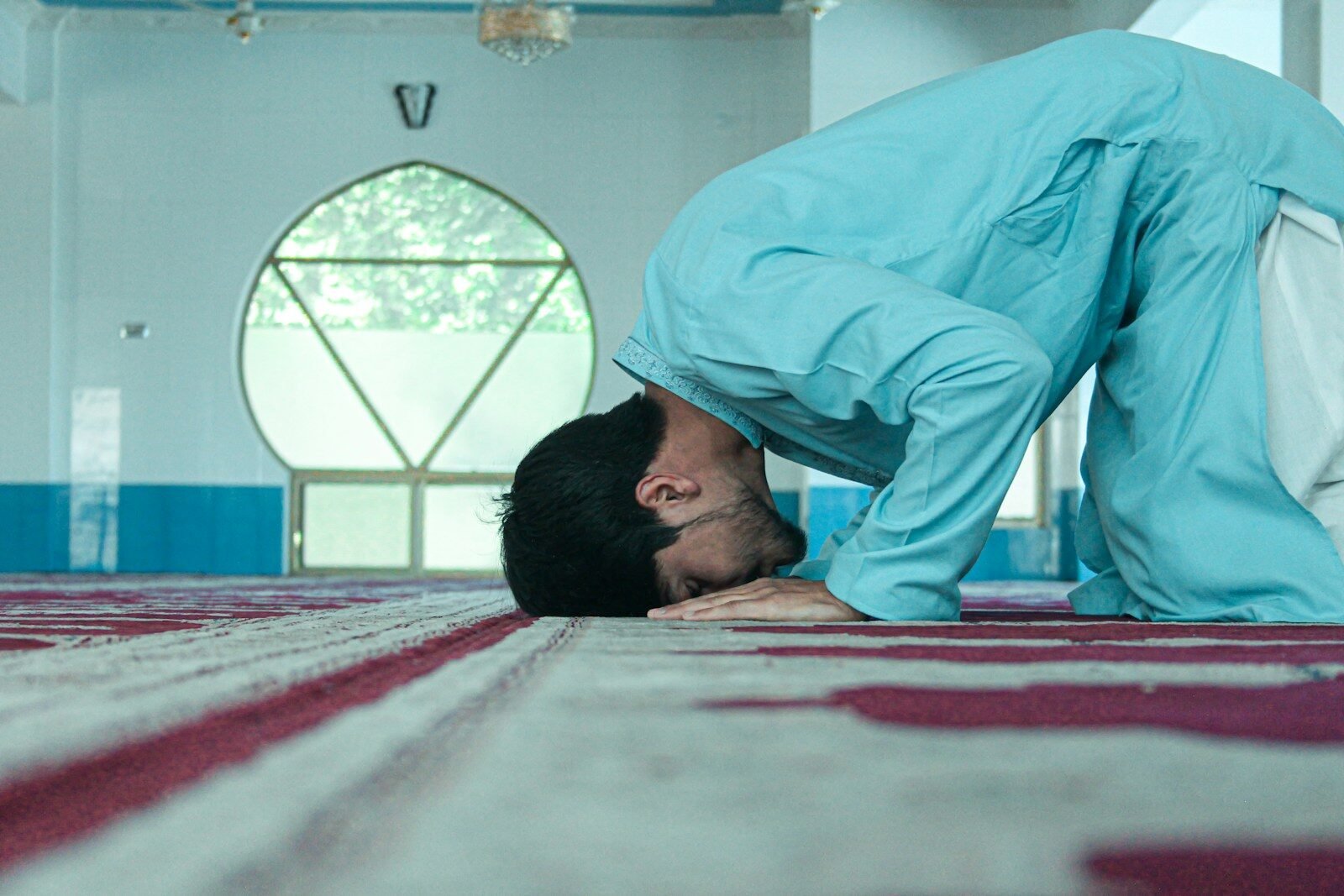
And through all of it — every single loss — there is not a single narration that shows the Prophet ﷺ struggling against the will of Allah. Grief yes. Tears yes. The humanity of loss, fully felt and fully expressed. But not resistance. Not the why that curls into resentment. Not the anger that becomes doubt.
When his son Ibrahim died as an infant, the Prophet ﷺ wept. When the companions were surprised, he said: “The eyes shed tears and the heart grieves, and we will not say except what pleases our Lord. And we are, O Ibrahim, saddened by your departure.” — Sahih al-Bukhari.
Three things in one sentence. Tears — permitted and present. Grief — acknowledged and real. And a commitment — in the middle of both — to say only what is pleasing to Allah. This is the model of accepting qadr while remaining human.
The difference between acceptance and resignation
One of the most important distinctions in the Islamic teaching on qadr is the difference between rida — contentment, acceptance — and istislam — passive resignation or giving up.
Rida is active. It is a choice made in full awareness of what has happened, to trust Allah’s wisdom over your own preferences. It does not eliminate pain. It gives pain a container. The Quran does not ask you to feel nothing. It asks you to feel what you feel within the framework of trust in Allah — to grieve without despairing, to want without demanding, to hope without requiring Allah to comply.
Passive resignation — simply going along with whatever happens with no engagement of heart or will — is not what the tradition is asking for. The Prophet ﷺ made dua for specific outcomes. He sought medicine when he was ill. He made plans and pursued them. He wanted things. He expressed that wanting to Allah. None of this is in conflict with qadr — because dua itself is part of the decree, and effort itself is part of the means Allah has decreed.
“Nothing can change Qadr except dua.” — Tirmidhi. This hadith is often misread as contradictory. How can dua change what is already decreed? The scholars’ answer is that dua itself is part of the decree — the change that results from dua was always going to happen through the dua. The lesson is not that qadr is malleable in a way that undermines its certainty. It is that dua is one of the means Allah has established and that abandoning it on the grounds that “everything is written anyway” is a misunderstanding of the entire framework.
Make dua. Strive. Plan. Seek. And then release the outcome to the One who always knew how it was going to end.
The practical path to acceptance
Understanding qadr intellectually is the beginning, not the end. The gap between knowing it and living it is crossed through specific practices, not through additional theology.
Muhasabah — honest self-examination. Much of what makes qadr hard to accept is not the event itself but the stories we tell about the event. He did this to me. This happened because of my failure. If I had done this differently. The practice of muhasabah — pausing and examining the narrative you’re running about what happened — exposes how much of your pain is the event and how much is the interpretation. The event is fixed. The interpretation is yours to work with.
Remembering the complete picture. The human mind in grief focuses on what was lost. The Quranic practice is to remember the full picture — what Allah has given, what He has protected you from that you never knew, what the ending of this particular chapter might be making space for. This is not toxic positivity. It is the deliberate, effortful expansion of perspective that the Quran calls on Muslims to practice. “If you were to count the favors of Allah, you could not enumerate them.” — Surah Ibrahim 14:34.
Returning to Al-Fattah — the Opener. One of the most important divine names for the experience of closed doors is Al-Fattah — the One who opens. Every door that closes in a Muslim’s life is closed by the One who has infinite other doors. The practice of returning to this name — invoking it, meditating on its meaning, making dua through it — is a specific spiritual technology for the experience of qadr that feels like loss.
Seeking the company of those who have lived it well. The biographical tradition of Islam — the seerah, the accounts of the companions, the stories of the scholars — is full of people who received the most devastating qadr and were transformed rather than destroyed by it. Reading these stories is not merely historical study. It is exposure to a different way of being in the world — one where the worst thing that happened to you becomes, through trust in Allah, the condition for the best thing that happened to you.
Saying the dua. When the Prophet ﷺ faced difficulty, he was specific in his invocation. “Inna lillahi wa inna ilayhi raji’un. O Allah, recompense me for my affliction and replace it for me with something better.” — Sahih Muslim. This is not a formula to be said mechanically. It is a theological statement — we belong to Allah and we are returning to Him — that reframes the entire experience of loss. What was taken was always Allah’s. Its return to Him is not theft. It is the completion of a loan.
Umm Salamah (RA) narrated that when her first husband Abu Salamah (RA) died, she said this dua in full belief that it would be answered — and then said to herself, “who could be better for me than Abu Salamah?” And then she married the Prophet ﷺ. The story is not a promise that your specific loss will be replaced with something specific you can identify. It is evidence that Allah’s replacement is real, and that it operates on a timescale and through a wisdom that exceeds what we can see from where we stand.
When acceptance feels impossible
There are losses that are so large — the death of a child, a devastating illness, a betrayal that restructures everything you thought was true, a dream that dies slowly over years — where the standard language of qadr can feel hollow or even cruel.
The tradition is honest about this. The Prophet ﷺ wept at the death of his son. Ibrahim ibn Adham, one of the great early Muslims, spent years in raw spiritual crisis before he found peace. The Quran itself documents the grief of Ya’qub (AS) weeping for Yusuf (AS) until he lost his sight.
There is no timeline in the Islamic tradition for how long acceptance takes. There is no required cheerfulness. The only requirement is that the grief does not become a theological position — that the pain does not harden into the belief that Allah is unjust, that His decree is arbitrary, that what happened to you is evidence against His mercy.
The scholars have said that grief is a condition of the heart, and conditions change. Acceptance is a direction, not a destination. You move toward it, imperfectly, over time, through the practices the tradition has given you. Some days you are closer. Some days something triggers the wound fresh and you start again from the beginning.
That is not failure. That is the human condition within the framework of faith.
What rida — true contentment — actually feels like
The scholars describe rida bil-qadr — contentment with the divine decree — not as the absence of feeling but as a deep interior settledness that coexists with feeling. It is possible to grieve and be at peace simultaneously. It is possible to wish something had gone differently and still genuinely trust that it was right. It is possible to not understand and not be undone by the not-understanding.
When you truly internalize belief in qadr, you no longer fear the unknown. Not because the unknown becomes known, but because the One who knows it is trusted completely. The unknowing remains. The terror of the unknowing is what changes.
This is the experience the Prophet ﷺ was describing when he said: “How amazing is the affair of the believer. Verily, all of his affairs are good for him — and this is for no one except the believer. If something good happens to him, he is grateful, and that is good for him. And if something bad happens to him, he is patient, and that is good for him.” — Sahih Muslim.
The word used for “how amazing” — ‘ajaban — is an expression of wonder and admiration. The Prophet ﷺ is saying that the believer’s relationship with qadr is genuinely remarkable. It converts every outcome — the ones they wanted and the ones they didn’t — into an occasion for a virtue that draws them closer to Allah. Gratitude for ease. Patience in hardship. Both lead to the same place.
That is not a burden. That is a gift.
A final word
Accepting the qadr of Allah is not a single moment of decision. It is a lifelong practice of returning — returning to trust when circumstances pull toward resentment, returning to surrender when ego wants control, returning to Allah when the distance between what you wanted and what happened feels unbridgeable.
The Quran says of those who truly accept qadr: “Verily, those who say ‘Our Lord is Allah’ and then remain steadfast — the angels descend upon them: ‘Fear not, nor shall you grieve. Receive glad tidings of Paradise.'” — Surah Fussilat 41:30.
The angels descend. That is not a metaphor for a vague spiritual feeling. It is a description of a specific divine response to a specific human posture — the posture of saying “Allah is my Lord” and then staying in that acknowledgment when life tests whether you mean it.
Stay. Return when you wander. Trust the One who wrote it.
He wrote it knowing exactly what it would cost you — and He wrote it anyway, because He also knows what it will give you.
Yala Media Group builds technology for the Muslim community where giving is structural, transparent, and effortless. Our browser extension turns everyday browsing and Amazon shopping into passive sadaqah — automatically, at no cost to you. Learn more at yalamediagroup.com.