Published by Yala Media Group | April 2026
The concept of hijrah — relocating to a place where one can observe Islamic obligations without restriction — is ancient in Islamic tradition. The first Muslims made hijrah from Makkah to Madinah. The companions made hijrah to Abyssinia. The principle that a Muslim should seek an environment conducive to their deen, even if it requires geographic sacrifice, is embedded in the tradition.
In 2026, hijrah takes a different form for many American and Western Muslims. It might mean relocating to a Muslim-majority country for cost of living reasons — stretching a dollar further, living debt-free, retiring early, or raising children in an Islamic cultural environment that requires less active effort to maintain than what’s available in the West. It might mean building a remote-work lifestyle that allows practice of the deen without the compromises that competitive Western employment can demand.
Whatever the motivation, the practical question is the same: where can a Muslim live well, live Islamically, and live affordably?
This guide covers the Muslim-majority countries that offer the best combination of cost of living, Islamic infrastructure, safety, and quality of life for expatriates in 2026. It is honest about trade-offs, because every affordable destination has them.
Note: costs cited are approximate based on Numbeo and Expatistan data for 2025-2026. Currency fluctuations and local conditions change; research current figures before making any relocation decision.

1. Malaysia — the overall best value for Muslim expats
For Muslim expats weighing a move abroad in 2026, Malaysia ranks first overall on cost of living, halal infrastructure, and safety. It combines affordable daily expenses, universal halal food access, quality healthcare, political stability, and a large English-speaking population.
Cost of living: A comfortable single-person life in Kuala Lumpur — including rent for a decent apartment, food, transportation, and utilities — runs approximately $800 to $1,200 per month. Couples can live well on $1,500 to $2,000 per month. Outside Kuala Lumpur in cities like Penang or Johor Bahru, costs drop further.
Islamic life: Malaysia is approximately 60% Muslim, and halal food is the default rather than the exception. Mosques are everywhere. The azaan is broadcast publicly. Jumu’ah is a recognized part of the weekly calendar. For Muslim families, the ease of Islamic practice is almost without parallel among affordable destinations.
English proficiency: Malaysia has one of the highest English proficiency rates in Southeast Asia, a legacy of its British colonial period. Business, government, and daily interaction in urban areas all function in English alongside Malay and Mandarin.
Digital nomad and expat infrastructure: Kuala Lumpur has excellent internet infrastructure, co-working spaces, and a well-established expat community. The MM2H (Malaysia My Second Home) program provides long-term residency for qualifying applicants.
Trade-offs: Tropical climate means heat and humidity year-round. Traffic in Kuala Lumpur is notorious. Some Westerners find the cultural adjustment to Southeast Asian norms takes time. Political stability, while generally good, has had periodic tension around religious and racial issues.

2. Morocco — the cheapest Muslim country with European access
Morocco offers a unique combination: a Muslim-majority country in North Africa, just an hour’s ferry ride from Spain, with Mediterranean climate, a rich Islamic cultural heritage, and one of the most affordable cost-of-living profiles among countries accessible from Europe.
Cost of living: A single person can live comfortably in Rabat or Fez for $600 to $900 per month. Marrakech is slightly more expensive but remains affordable by Western standards. Food is extremely cheap — the country’s fresh produce, tagines, and street food are world-class in quality and almost nothing in cost.
Islamic life: Morocco is 99% Muslim. The medinas of Fez and Marrakech contain some of the most beautiful medieval Islamic architecture in the world. The University of Al-Qarawiyyin in Fez — widely considered the oldest continuously operating university in the world — is an Islamic institution with centuries of scholarship. For Muslims interested in Islamic studies, Morocco has extraordinary scholarly resources.
Climate and lifestyle: Morocco’s climate ranges from Mediterranean coastal weather to desert in the south. The country’s food, hospitality culture, and traditional craftsmanship create a quality of daily life that is rich far beyond what the price tag suggests.
European access: The geographic proximity to Europe makes Morocco particularly valuable for Muslims who want to maintain European connections, do business in Europe, or travel frequently within the EU.
Trade-offs: Infrastructure quality varies significantly between urban and rural areas. Tourist-oriented areas can feel economically different from local neighborhoods. Finding stable high-speed internet for remote work requires research in advance. Political situation is generally stable but regional dynamics require monitoring.

3. Egypt — deep Islamic heritage, extremely affordable
Egypt ranks consistently among the most affordable countries in the world on cost-of-living indices. A single person can live on under $500 per month in Cairo, including rent, food, and transportation. By global standards, this is almost nothing.
Cost of living: Cairo offers perhaps the most affordable combination of urban amenities and cost of any major Muslim city. A one-bedroom apartment in a decent neighborhood rents for $150 to $350 per month. Street food is extraordinary and costs almost nothing. Transportation is cheap. The city’s scale and infrastructure are enormous.
Islamic life: Egypt is approximately 90% Muslim. Cairo has thousands of mosques, including the iconic Al-Azhar Mosque — one of the oldest universities in the world and the most authoritative Sunni Islamic institution in existence. For Muslims serious about Islamic education, Cairo is arguably the most significant city on earth.
Islamic scholarship: Studying at Al-Azhar or its affiliated institutions is available to international students, and the scholarly tradition of Cairo is unmatched in the Sunni world. The city’s Islamic bookshops, lecture circles, and scholarly institutions represent a depth of Islamic knowledge infrastructure that few places can approach.
Trade-offs: Egypt has faced economic instability, currency depreciation, and inflation challenges in recent years. This is a double-edged sword — it makes Egypt cheap for dollar or euro earners, but it also represents economic risk. Infrastructure quality in some areas is inconsistent. Air quality in Cairo is poor. Political freedoms are constrained by most international measures. Research current stability conditions before relocating.

4. Turkey — European lifestyle at Muslim-country prices
Turkey is one of the most popular expat destinations in the world, and for Muslim expats specifically it offers a combination of secular legal structure, deep Islamic cultural identity, European-adjacent lifestyle, and (in recent years) dramatically reduced cost of living due to currency depreciation.
Cost of living: Following years of significant lira depreciation, Turkey has become extraordinarily cheap for dollar and euro earners. A comfortable lifestyle in Istanbul — rent, food, transport, entertainment — can be had for $800 to $1,400 per month. Ankara and other cities are significantly cheaper. The currency situation has stabilized somewhat but Turkey remains far cheaper for Western earners than it was five years ago.
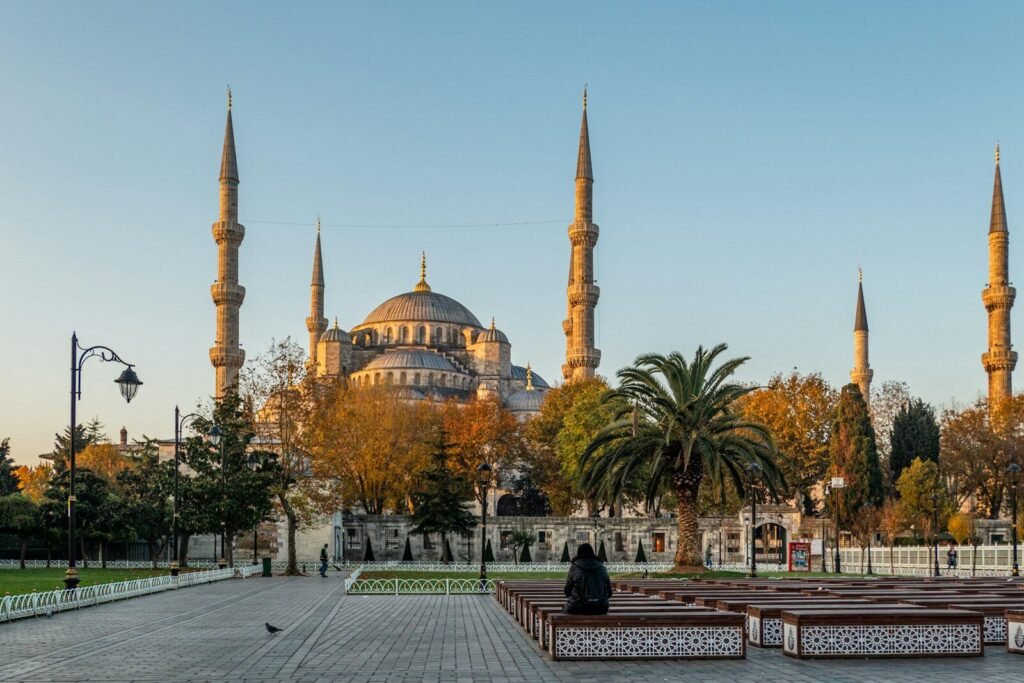
Islamic life: Turkey is approximately 99% Muslim and has undergone a significant shift toward Islamic cultural visibility over the past two decades. Mosques are everywhere, the azaan is broadcast publicly, and halal food is the default. The Sufi heritage of Turkey — the Mevlana tradition, the Ottoman mosques, the religious scholarship — gives Istanbul specifically a unique spiritual depth.
European connectivity: Turkey’s geographic position — bridging Europe and Asia — and its EU customs union make it one of the most connected Muslim countries to the European economy. Istanbul’s airports are among the most internationally connected in the world.
Culture and lifestyle: Istanbul is one of the great cities of the world by any measure. The food, the architecture, the history, the Bosphorus, the arts scene — it provides a quality of urban cultural life that few cities anywhere can match.
Trade-offs: Political situation requires monitoring — press freedom and rule of law indicators have declined over the past decade. Earthquake risk in Istanbul is real and documented. The currency situation, while currently favorable for Western earners, carries uncertainty. Turkish bureaucracy can be challenging for expats.

5. Pakistan — deepest affordability, strongest Islamic community
Pakistan ranks among the cheapest countries in the world by absolute cost. A comfortable life in Lahore or Islamabad for a single person runs $300 to $600 per month. For American or European Muslims earning in their home currency remotely, Pakistan offers a purchasing power that is almost unparalleled.
Cost of living: Pakistan’s cities offer extraordinary affordability. Lahore’s food scene — widely considered one of the best in South Asia — is phenomenally cheap. Housing is inexpensive. Transportation is cheap. The country’s bazaars, restaurants, and markets are world-class experiences at minimal cost.
Islamic life: Pakistan is approximately 96% Muslim and Islamic practice is deeply embedded in daily life. The azaan is broadcast from thousands of mosques five times daily. Ramadan is observed at a national scale. Jumu’ah is a community-wide institution. For American Muslims with South Asian heritage, Pakistan offers the most direct connection to their cultural and religious roots.
Trade-offs: This is where honesty is essential. Pakistan faces significant challenges: political instability and periodic political crisis, security concerns that vary dramatically by region (Lahore and Islamabad are considerably safer than many other areas), infrastructure that is inconsistent in quality, power outages that affect daily life in many areas, and economic volatility. For Westerners accustomed to stable institutions and consistent infrastructure, the adjustment is real. Research current conditions carefully and consider a trial visit before committing to relocation.

6. Indonesia — the world’s largest Muslim population, affordable and vast
Indonesia is home to more Muslims than any other country on earth — approximately 230 million — and offers a range of cost-of-living options across its 17,000 islands. Bali (for lifestyle), Yogyakarta (for culture), and Jakarta (for career) each offer different profiles.
Cost of living: Outside of the tourist-inflated areas of Bali’s main strip, Indonesia is genuinely affordable. A comfortable life in Yogyakarta runs $500 to $800 per month. Bali in non-tourist areas is similar. Jakarta is more expensive but still far below Western costs.
Islamic life: Indonesia’s Islam has a distinct character — deeply rooted but shaped by Southeast Asian culture in ways that differ from Arab or South Asian Islam. Mosques are omnipresent. Islamic schools and universities are numerous. The country’s largest Islamic organizations — Nahdlatul Ulama and Muhammadiyah — represent Islamic civil society at an extraordinary scale.
Natural beauty: Indonesia’s landscape is one of the most spectacular on earth — volcanic mountains, rice terraces, beaches, rainforests, and extraordinary biodiversity. Quality of life from a natural beauty perspective is exceptional.
Trade-offs: Indonesia is vast and infrastructure quality varies enormously by island and region. The country’s political democracy is generally stable. Learning Bahasa Indonesia makes daily life considerably easier and more connected. Traffic in Jakarta is legendarily terrible.

7. Albania — cheapest Muslim country in Europe
Albania is a frequently overlooked option for Muslim expats who want to stay within or adjacent to Europe. A Muslim-majority country on the Adriatic coast with Mediterranean climate, beautiful mountain scenery, stunning beaches, and a cost of living that makes it one of the most affordable places in Europe.
Cost of living: A single person can live comfortably in Tirana, the capital, for $700 to $1,000 per month. This includes rent, food, and entertainment in what is a growing and increasingly lively small city. Coastal towns in summer are beautiful and affordable by European standards.
Islamic life: Albania is approximately 57% Muslim, with a Sufi heritage particularly through the Bektashi order. The country’s Islamic identity survived fifty years of communist atheism and has reasserted itself with the restored religious freedom of the post-communist era. Mosques are growing in number and Islamic practice is increasingly visible.
European access: Albania is currently a candidate for EU membership and operates with significant European economic integration. The geography makes travel to Italy, Greece, and the broader Balkans straightforward.
Trade-offs: Albania is a small country with a developing economy. Job opportunities for non-Albanian speakers are limited — this is primarily an option for remote workers or retirees. Infrastructure development is ongoing and inconsistent. English is increasingly spoken in urban areas but less so in rural regions.
What to consider before relocating
Remote income is the key enabler. The countries on this list are most viable for Muslim Americans and Europeans who earn income in dollars or euros while living in a country with a lower-cost currency. Without this earning differential, the affordability advantage narrows dramatically. Confirm your remote work arrangements before relocating.
Visit before you commit. No amount of research replaces spending two to four weeks in a country experiencing daily life before deciding to move there. What reads as affordable and appealing in an article can feel very different when you’re navigating local bureaucracy, dealing with infrastructure challenges, or discovering that the lifestyle trade-offs are larger than expected.
Community matters as much as cost. The Muslim expat community in your chosen city will be a significant factor in your wellbeing. Research which cities within each country have established expat Muslim communities — they exist in all of the countries above in varying sizes and can provide practical support, social connection, and Islamic community that makes the transition manageable.
Visa and legal status. Every country on this list has different requirements for long-term residency. Research the specific visa pathway available for your situation — digital nomad visas, retirement visas, investment visas, and long-term stay permits vary enormously by country and change periodically. Confirm current requirements with the relevant embassy before making plans.
Yala Media Group builds technology for the Muslim community where giving is structural, transparent, and effortless. Learn more at yalamediagroup.com.