Published by Yala Media Group | April 2026
The question deserves to be asked plainly: does Allah love us?
Not in the abstract — does the Creator of the universe have something that could be called love for the human beings He created? Something real, something particular, something that reaches into the specific circumstances of individual lives?
The Quran answers this question not with philosophical argument but with direct declaration.
“Indeed, Allah loves those who repent and loves those who purify themselves.” — Surah Al-Baqarah 2:222.
“Allah loves the doers of good.” — Surah Al-Baqarah 2:195.
“Indeed, He is oft-Forgiving and Loving.” — Surah Al-Buruj 85:14.
The divine name Al-Wadoud — the Loving, the Most Affectionate — appears in the Quran directly, describing Allah’s own nature. This is not a metaphor. It is a theological statement about what Allah (SWT) actually is.
Understanding how Allah loves us — not just that He does, but how — is one of the most transformative theological questions a Muslim can engage with. This article explores that question through the Quran, the Sunnah, and the classical Islamic understanding of divine love.
Al-Wadoud — what the name means
The divine name Al-Wadoud appears in Surah Hud (11:90) and Surah Al-Buruj (85:14). The Arabic root w-d-d carries connotations of deep, warm, continuous affection — the kind of love that is tender and persistent rather than transactional or conditional.
The scholars distinguish between Allah’s mahabba — His love — and human love. Allah’s love is not dependent on need, not contingent on reciprocation, not subject to the fluctuations that human love undergoes. It is perfectly complete in itself, consistent, and overwhelming in scale in a way that human love can only gesture toward.
Imam Ibn al-Qayyim described the divine love as the highest reality in the universe — the source from which all created love flows, the original of which every beautiful human affection is a pale reflection. When a mother loves her child with an intensity she cannot explain, she is experiencing a derivative of the love that originated in Allah. When two people feel genuine love for each other that makes the world seem different, they are touching the edge of something that exists in its fullness only in Allah (SWT).
The love expressed before you existed
One of the most profound dimensions of Allah’s love is that it preceded you. Before you were born, before your parents met, before the events that produced your particular life — Allah’s plan for you was already established in loving detail.
“And He found you lost and guided you.” — Surah Ad-Duha 93:7.
“Did We not expand for you your chest?” — Surah Ash-Sharh 94:1.
Surah Ad-Duha was revealed at a moment of profound darkness for the Prophet ﷺ — a period when revelation had paused and he feared Allah had abandoned him. The divine response is one of the most tender passages in the entire Quran: Did We not find you an orphan and give you shelter? Did We not find you lost and guide you? Did We not find you poor and enrich you? Each question points to a specific act of care that preceded anything the Prophet ﷺ had done to deserve it.
The scholars use this passage to establish a principle: Allah’s love and care often act before we have asked for them, before we have recognized our need, before we have done anything to earn them. The love preceded the deed.
For the individual Muslim, this means: every moment of your life that led you to faith — the specific sequence of events, encounters, books, and people that brought you to where you are — reflects an intelligent and loving arrangement. Allah was guiding you before you knew you were being guided.
How Allah shows love: the specific expressions
Through provision — rizq as an act of love
Every sip of water, every breath of air, every meal, every moment of health — these are specific acts of divine provision that the Quran consistently frames as expressions of divine care and love. “And He gives you from all you ask of Him. And if you should count the favor of Allah, you could not enumerate them.” — Surah Ibrahim 14:34.
The provision is not reserved for believers. Allah provides for everyone — Muslim and non-Muslim, righteous and wicked — because provision is an expression of Al-Razzaq (the Provider) that operates universally. But the Quran asks believers to see provision differently — not as the impersonal operation of natural systems, but as continuous acts of care from a Being who knows exactly what you need.
The small provisions are as deliberate as the large ones. The meal that arrived exactly when you needed it. The health that allowed you to pray. The breath that was there when you drew it. Nothing that sustains your existence is accidental.

Through tribulation — love expressed through difficulty
This is the dimension of divine love that is hardest to receive, and the Quran does not pretend otherwise.
The Prophet ﷺ said: “The greatest reward comes with the greatest trial. When Allah loves a person He tests them.” — Tirmidhi.
“Do people think that they will be left alone because they say: ‘We believe,’ and will not be tested?” — Surah Al-Ankabut 29:2.
The Islamic theology of trial is not masochism. It is the recognition that difficulty — when responded to with patience and trust — produces qualities of character that ease cannot produce. Sabr, tawakkul, gratitude, depth — these are not available on the easy path. They are the gifts of the difficult one.
The analogy the scholars use: a loving parent who allows their child to struggle with a difficult homework problem rather than simply giving them the answer is not being cruel. They are refusing the cruelty of raising a child who cannot solve problems. Allah’s trials are, in this framework, acts of investment rather than punishment — refining the believer into something capable of carrying more spiritual weight than the untested person can bear.
This does not mean every difficulty is a sign of love, or that suffering should be welcomed uncritically. It means that for the believer, nothing that Allah decrees is without purpose — and that the purpose is consistently connected to growth, refinement, and ultimately a closeness to Allah that the comfortable path could not have produced.
Through forgiveness — love as the willingness to restore
One of the most direct expressions of divine love is the fact that Allah has made forgiveness available. Not as a reluctant concession but as a central feature of His relationship with human beings.
“Say, ‘O My servants who have transgressed against themselves — do not despair of the mercy of Allah. Indeed, Allah forgives all sins. Indeed, it is He who is the Forgiving, the Merciful.'” — Surah Az-Zumar 39:53.
The hadith qudsi — divine hadith narrated from Allah directly — describes the divine relationship to repentance in terms of extraordinary joy: “Allah is more pleased with the repentance of His slave than a man who was on his camel in a barren desert, and it ran away carrying his food and drink. Despairing of it, he went to a tree and lay down in its shade — then he suddenly found it standing before him.” — Sahih al-Bukhari.
The comparison is deliberate: the joy of finding water in a desert when you thought you would die of thirst. That is how Allah receives the repentance of a slave who returns to Him. A love that receives sinners back with joy is a love of extraordinary depth.
Through the sending of prophets — love as guidance
“Certainly did Allah confer great favor upon the believers when He sent among them a Messenger.” — Surah Ali Imran 3:164.
The sending of the Prophet ﷺ — and before him, of the 124,000 prophets the tradition describes — is itself an expression of divine love. Allah did not simply create humanity, give them free will, and watch. He sent guidance, repeatedly, across every era and every people, because He did not want them to be lost.
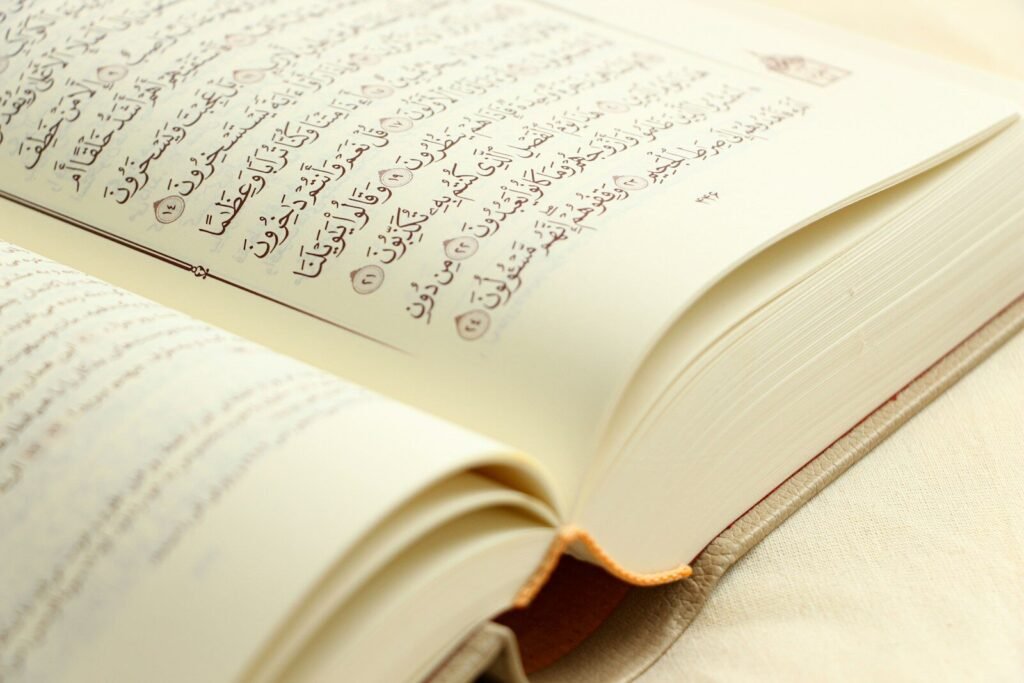
The Quran — described as a healing and a mercy — is Allah’s most complete and preserved gift of guidance to humanity. To have access to this book, to be able to read in it the direct words of the One who created you, is an act of love whose scale is difficult to fully appreciate.
Through the quality of divine names themselves
The most commonly recited declaration in Islamic practice is Bismillah ir-Rahman ir-Rahim — in the name of Allah, the Entirely Merciful, the Especially Merciful. Two names rooted in the Arabic rahma — mercy, compassion, tenderness — that derive from the same root as rahim, the womb. The scholars note that Allah opens every surah of the Quran (except Al-Tawbah) with this declaration — foregrounding mercy as the frame within which all of His action is understood.
The Prophet ﷺ said that Allah has divided mercy into 100 parts. He kept 99 with Himself and sent down one part to the earth. From this one part, all mercy between created beings flows — the mother’s tenderness toward her child, the care between strangers, the affection between friends. And the 99 parts that Allah kept are reserved for the believers on the Day of Judgment. — Sahih al-Bukhari.
Conditions on Allah’s love — the types of people He loves
The Quran describes specific qualities that Allah loves, which gives the believer a practical guide to drawing closer to a love that is always available:
“Allah loves those who are constantly repentant.” — 2:222
“Allah loves the doers of good.” — 2:195 “Allah loves those who are just.” — 5:42
“Allah loves those who are patient.” — 3:146
“Allah loves those who put their trust in Him.” — 3:159
“Allah loves those who purify themselves.” — 9:108
These are not conditions for Allah’s care to begin — His care exists before any of these qualities. They are conditions for a specific, elevated dimension of divine love — the kind that the Quran describes as being directed toward specific qualities rather than simply toward all people universally. The believer who develops these qualities is moving closer to the center of divine love rather than its periphery.
Loving Allah in return: the relationship is bilateral
“Say, ‘If you should love Allah, then follow me, so Allah will love you and forgive you your sins.'” — Surah Ali Imran 3:31.
This ayah — sometimes called the ayah of love — establishes that the human love for Allah is expressed through following the Prophet ﷺ, and that this expression results in Allah’s love and forgiveness. The relationship is not one-directional. It is a bilateral love — Allah loving the believer, the believer responding in love and action, Allah’s love deepening in response to the believer’s love.
The Prophet ﷺ described the mechanism of this increasing closeness: “Allah says: ‘Whoever comes close to Me by one handspan, I come close to him by one cubit; whoever comes close to Me by one cubit, I come close to him by a fathom. If My servant comes to Me walking, I come to him running.'” — Sahih al-Bukhari.
The image of Allah running toward the servant who walks toward Him is one of the most tender images of divine love in the entire prophetic tradition. Every small step toward Allah is met with a movement toward you that dwarfs your approach.
Living with the knowledge of divine love
Understanding that Allah loves you is not a passive theological belief. It should transform how you experience every dimension of your life.
The difficulty that arrived — it came from the One who loves you.
The provision that found you — it came from the One who loves you.
The guidance that reached you — it came from the One who loves you.
The forgiveness that is always available — it comes from the One who loves you.
The believer who has genuinely internalized Al-Wadoud experiences the world differently. Not without pain — the Quran doesn’t promise a painless life. But with the knowledge that nothing reaches them except through the will of the One whose love for them is real, complete, and permanent.
“And He is with you wherever you are.” — Surah Al-Hadid 57:4.
With you. Not watching from a distance. With you.
Yala Media Group builds technology for the Muslim community where giving is structural, transparent, and effortless. Learn more at yalamediagroup.com.