Published by Yala Media Group | April 2026
Wudu at work is one of those things that sounds more complicated than it is. Most Muslim professionals who pray consistently at work have figured it out within a few weeks — and almost universally report that it is less awkward, less time-consuming, and less conspicuous than they initially feared.
The average wudu takes three to five minutes in a standard office restroom. It is entirely doable in most American workplace environments without any special accommodation, without drawing attention to yourself, and without interrupting the workday in any meaningful way. What it requires is knowing the process, having a few practical tools, and building the habit.
This guide covers the fiqh of wudu in brief, the practical process in a workplace restroom, tips from Muslim professionals who have been doing this for years, the question of wiping over socks (masah), and how to handle wudu in specific workplace situations.
What wudu requires — the essentials
Wudu has six obligatory acts (fard) according to the majority scholarly opinion:
- Niyyah — intention in the heart. No verbal pronouncement is required.
- Washing the face — from hairline to chin, ear to ear, once.
- Washing the hands and arms — to and including the elbows, once.
- Wiping the head — passing wet hands over the head once, from front to back.
- Washing the feet — to and including the ankles, once.
- Tartib — performing these acts in order.
The Sunnah adds additional elements — beginning with Bismillah, washing the hands three times at the start, rinsing the mouth and nose, washing each element three times rather than once, wiping the ears, and beginning with the right side — but these are recommended enhancements, not requirements. A valid wudu can be performed efficiently in a workplace restroom in three to five minutes.

The workplace wudu process: step by step
Step 1 — Choose your location
The most practical options, in order of preference:
Single-occupancy restroom — if your workplace has a single-occupancy or gender-neutral bathroom, this is ideal. Lock the door, take your time, no audience. This is the most comfortable option for new wudu practitioners.
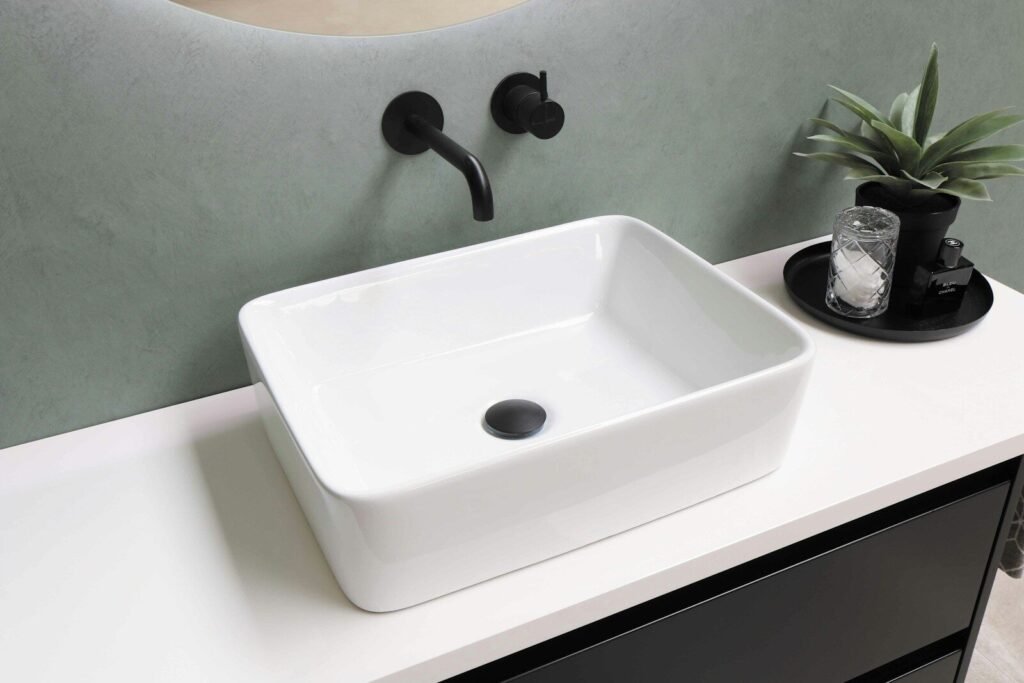
Standard multi-stall restroom sink — completely workable for most of the wudu. The only logistics challenge is foot-washing, which we’ll address separately.
Wellness room, meditation room, or mother’s room — some offices have these with sinks. If yours does and colleagues are comfortable with shared use, worth considering.
Step 2 — Prepare before you approach the sink
Before turning on the water, remove your watch and any rings or bracelets on your wrist and forearm — water needs to reach the skin underneath. Have your prayer mat or a small towel within reach.
If you’re wearing laced shoes, consider whether you’ll be wiping over your socks (see the masah section below). If yes, you can skip foot-washing entirely — a significant time-saver.
Step 3 — The wudu sequence at the sink
Intention — in your heart as you begin.
Hands — wash both hands including between the fingers, to the wrist. Three times is sunnah, once is sufficient.
Mouth and nose — cup water in your right hand, rinse your mouth, spit. Cup water again, sniff into your nose gently, blow out. Three times each.
Face — splash water over your entire face from hairline to chin, ear to ear. Make sure water reaches the beard if applicable. Three times.
Arms — wash right arm from fingertips to elbow, including the elbow. Then left arm. Three times each.
Head — cup both hands, wet them, pass them over your head once from front to back, then back to front.
Ears — wet index fingers, pass them inside the ears; wet thumbs, pass them behind the ears.
Feet — see below.
Step 4 — Foot washing at work
This is the element most Muslim professionals find logistically awkward, and it deserves honest treatment.
Option A: Sink method — lift your foot to the sink level, hold onto the sink or wall for balance, and wash. This works in restrooms with lower sinks and requires some flexibility and balance. Many Muslim professionals do this without difficulty once they’ve practiced it a few times. It is not as acrobatic as it sounds.
Option B: Bottle method — keep a small plastic water bottle in your bag. Fill it at the sink, take it to a toilet stall, and pour water over each foot while sitting on the toilet lid. This is the most private and practical option for many workplace situations. A squeeze sport bottle works particularly well.
Option C: Masah over socks — if you follow the opinion that wiping over leather or waterproof socks is permissible, you can wipe over your socks rather than washing your feet. This eliminates the logistical challenge entirely. See the masah section below.
Masah over khuffain (wiping over socks): what you need to know
The masah over khuffain — wiping over leather socks or waterproof socks — is one of the most practically useful concessions in Islamic jurisprudence for Muslim professionals.
The basic ruling: Rather than washing your feet for wudu, you wipe over socks that cover the ankle, worn after a valid wudu in which the feet were washed. The wipe is performed once, passing wet hands over the top of the sock.
Duration: For a resident (non-traveler), masah is valid for 24 hours from the moment it was first used. For a traveler, 72 hours.
What breaks masah: Anything that breaks wudu breaks masah. Additionally, masah is nullified by removing the socks, by the expiration of the time period, and by major ritual impurity (janabah) requiring ghusl.
What qualifies as masah-eligible socks: The classical position requires leather khuffs. Many contemporary scholars, including the majority of modern fatawa from major institutions, permit masah over thick waterproof socks that cover the ankle and do not slip. Consult your own scholarly reference for the position your madhab takes and which specific sock types qualify.
The practical benefit: If you put on your socks after wudu in the morning and they qualify for masah, you can perform wudu for every prayer during the workday without removing your shoes or washing your feet at all — simply wiping over the socks. This makes workplace wudu substantially easier and faster.
Practical tips from Muslim professionals
Keep a small towel at your desk. A dedicated wudu towel — separate from your personal towel, kept in your bag or desk drawer — is more dignified, more hygienic, and more effective than paper towels. A small microfiber travel towel dries quickly and takes up almost no space.
Wear slip-on shoes when praying at work. If you’re not using masah, wearing shoes that come off easily — loafers, Chelsea boots, slip-ons — makes foot-washing dramatically easier than laced shoes.
Choose a sink with counter space. In multi-sink restrooms, choose the sink at the end of the row — more counter space for your items, slightly more privacy, and easier to perform wudu without feeling crowded.
Perform wudu before the prayer window becomes tight. Many Muslim professionals find it easier to perform wudu five to ten minutes before the prayer window rather than at the last minute when the time pressure makes the process feel rushed.
Know where the accessible restroom is. Accessible (disabled) restrooms often have more space, a single-occupancy lock, and grab bars that help with balance during foot-washing. They are not exclusively for disabled users — they are available for anyone’s use, and Muslim professionals who use them for wudu are using them for a legitimate purpose.
Keep a prayer mat in your office or bag. A small travel prayer mat that folds into a compact square is available from most Islamic bookstores and online. Having it accessible means you’re not improvising a prayer space every time.
Common workplace wudu scenarios
Open-plan office with shared gender-neutral bathrooms: The single-occupancy option is ideal. Book or claim it at your prayer window if possible. The bottle method for feet works well here.
Corporate high-rise with large multi-stall restrooms: Use the end sink. Bring your towel. Master the balance-and-lift foot-washing technique or use masah. The environment will be busy but nobody is watching you as carefully as you think.
Client site or unfamiliar office: Scout the restroom before your prayer time. Know where the accessible restroom is. Keep your water bottle in your bag as a backup for the foot-washing. You’ll figure it out faster than you expect.
Remote work from home: The simplest scenario. Perform wudu in your own bathroom without any of the workplace considerations. The only logistics question is whether your home setup has everything you need — a prayer mat pointed toward the qibla, clean socks for masah if you use it.
Travel for work — hotels: Hotel bathrooms are generally excellent for wudu — private, spacious, with a reliable water supply. The only challenge is finding the qibla direction in an unfamiliar room, which your phone handles instantly.
Wudu and its spiritual dimension at work
The Prophet ﷺ said: “Wudu is half of faith.” — Sahih Muslim.
This hadith is not hyperbole. It reflects the deep significance of ritual purity in Islamic worship — the intentional preparation of the body for standing before Allah. A Muslim who performs wudu at work is doing something more than a hygiene routine. They are making a physical, intentional transition from the mode of work to the mode of worship. They are asserting — in the middle of a meeting-filled, deadline-driven, professionally demanding day — that they are first and foremost a servant of Allah, and that this identity takes precedence.
That assertion, made five times a day through the simple act of ritual washing in a workplace restroom, is one of the most powerful spiritual practices available to the Muslim professional. The slight awkwardness of the first few times is completely worth it. The habit, once established, feels like what it is: normal.
Yala Media Group builds technology for the Muslim community where giving is structural, transparent, and effortless. Learn more at yalamediagroup.com.