Published by Yala Media Group | April 2026
The Prophet ﷺ was physically active. He wrestled. He ran. He swam. He rode horses. He carried water and helped with household tasks. He was not sedentary, and the physical culture of early Islam — archery, riding, swimming, foot racing — reflects a tradition that understood the body as an amanah that deserves care and development. The below article discusses the best in-home workouts for Muslims in 2026 and how you can incorporate them into your own routine.
“Your body has a right over you.” — Sahih al-Bukhari.
The challenge for many Muslim Americans is not motivation — it is access. Gym environments can create real friction: mixed-gender spaces, music, immodest dress standards, social dynamics that don’t align with Islamic values.
For Muslim women especially, finding a workout environment that accommodates hijab and modesty requirements without making exercise itself feel like a second-class experience has historically been a challenge.
The solution is increasingly in-home fitness — which has become significantly better, more varied, and more effective since the pandemic accelerated the development of home workout infrastructure. You don’t need a gym to build strength, maintain cardio fitness, or develop the kind of physical discipline the Prophet ﷺ modeled. You need a plan, a space, and consistency.
This guide covers the best in-home workout approaches for Muslim adults in 2026 — structured to work around prayer times, Ramadan schedules, and the realities of busy Muslim family life.
Before you begin: the Islamic approach to physical fitness
Understanding why you’re exercising shapes how you exercise.
The Islamic tradition frames physical fitness as part of fulfilling the trust Allah placed in your body — not as vanity, not as a performance for others, but as stewardship. A Muslim who is physically strong and healthy is better equipped to worship, to serve their family, to contribute to their community, and to fulfill their Islamic obligations over a longer and more capable life.
The scholars have also noted that physical strength has a dimension of communal obligation — the stronger the Muslim community physically, the better equipped it is to fulfill its responsibilities in the world. Umar ibn al-Khattab (RA) reportedly said: “Teach your children swimming, archery, and horse riding.” This was not recreational advice — it was a vision of a physically capable ummah.
Practical Islamic considerations for in-home workouts:
Prayer times take priority. Schedule your workout sessions to avoid prayer windows, or build in prayer breaks as natural rest intervals in your routine. Dhuhr as a transition between morning and afternoon work, Asr as a break in the afternoon session — treating prayer as a feature of your workout schedule rather than an interruption of it.
Ramadan adjustment. In-home workouts during Ramadan are manageable with adjusted intensity and timing. Working out after Tarawih prayer — in the late evening after Iftar when you’ve eaten and prayed — is the most common approach for observant Muslims who want to maintain fitness through Ramadan. Reduce intensity by about thirty percent and stay well-hydrated in the hours before Suhoor.
Modesty at home. One of the clearest advantages of in-home workouts for Muslim women is the complete freedom to exercise in whatever attire is comfortable and functional without modesty considerations. This removes one of the primary barriers many Muslim women report in mainstream gym environments.

The best in-home workout categories for Muslim adults
1. Bodyweight training — the foundation
Bodyweight training requires zero equipment, can be done in a small space, and produces measurable strength, endurance, and body composition results. It is the most accessible form of in-home fitness and the most time-efficient for busy adults.
The foundational movements:
Push-ups — the most versatile upper body exercise. Standard, wide-grip, diamond, decline, and pike push-up variations provide enough range to train the chest, shoulders, and triceps at every level from beginner to advanced.
Squats — bodyweight squat, sumo squat, jump squat, and single-leg variations train the legs and glutes comprehensively. No equipment required.
Planks and core work — front plank, side plank, hollow body hold, dead bug, and mountain climbers develop the core stability that supports everything from salah to carrying children.
Lunges — forward, reverse, and lateral lunges train balance and single-leg strength simultaneously.
Burpees — the full-body movement that combines squat, plank, and jump into one of the most effective cardiovascular and strength conditioning exercises available without equipment.
A simple beginner bodyweight routine:
3 rounds of:
- 10 push-ups (modify to knees if needed)
- 15 squats
- 10 reverse lunges each leg
- 30-second plank
- 10 burpees (modify to step-back burpees if needed)
Rest 60-90 seconds between rounds. Total time: approximately 20-25 minutes.
2. Yoga and Islamic-aligned stretching
Yoga has a complex relationship with the Muslim community — the practice originated in a Hindu spiritual context, and some scholars have concerns about the spiritual dimensions of certain yoga traditions. The scholarly consensus generally permits yoga as a physical practice (for flexibility, strength, and stress relief) while cautioning against any spiritual or meditative dimensions that involve non-Islamic beliefs or invocations.
For Muslim adults who want to practice yoga strictly as a physical exercise — attending to the breath, the movement, and the physical benefit without the spiritual overlay — many Islamic educators consider this permissible. Consult your own scholarly reference for guidance specific to your madhab and circumstances.
The practical benefits of yoga-style stretching for Muslim adults are significant: improved flexibility directly enhances prayer quality — deeper, more comfortable sujood, easier transitions between positions. Reduced physical tension improves focus during salah. Hip flexibility and hamstring length make sitting in tashahhud more comfortable for adults who spend most of the day at a desk.
Yoga-style stretching you can do at home:
Child’s pose — excellent hip and lower back stretch. Cat-cow — spinal mobility, directly improves comfort in ruku and sujood. Pigeon pose — hip opener critical for comfortable floor sitting. Downward dog — full-body stretch combining hamstrings, calves, and shoulders. Seated forward fold — hamstring and lower back.
Twenty minutes of targeted stretching after any workout — or as a standalone practice after Fajr — produces measurable flexibility improvement within four to six weeks of consistency.

3. HIIT — High Intensity Interval Training
HIIT produces cardiovascular and metabolic fitness in significantly less time than steady-state cardio. For Muslim adults with busy schedules — juggling family, work, community commitments, and Islamic obligations — twenty to thirty minutes of effective HIIT is often more sustainable than sixty minutes of moderate cardio.
HIIT alternates between periods of high-intensity effort and rest. The simplest format: 40 seconds of work, 20 seconds of rest, repeated for 8-10 rounds with 2-3 exercise variations.
A sample HIIT workout (30 minutes, no equipment):
Warm up: 5 minutes of light movement — arm circles, leg swings, walking in place.
Circuit 1 (3 rounds):
- 40 sec: Jumping jacks
- 20 sec: Rest
- 40 sec: Squat jumps
- 20 sec: Rest
- 40 sec: High knees
- 20 sec: Rest
Rest 1 minute.
Circuit 2 (3 rounds):
- 40 sec: Push-ups
- 20 sec: Rest
- 40 sec: Mountain climbers
- 20 sec: Rest
- 40 sec: Burpees
- 20 sec: Rest
Cool down: 5 minutes of walking and stretching.
4. Resistance training with minimal equipment
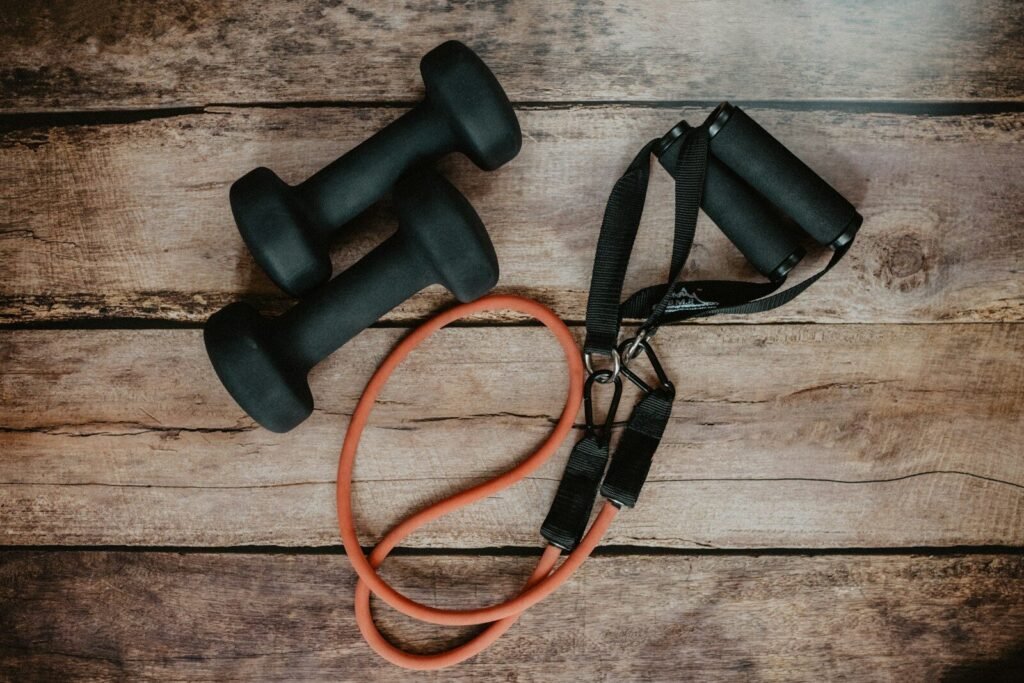
A pair of adjustable dumbbells — or resistance bands, which are inexpensive and take up almost no space — unlocks a complete resistance training program that produces muscle strength and definition that bodyweight training alone cannot fully replicate.
Resistance bands are particularly well-suited to in-home training: they are inexpensive ($15-$40 for a quality set), travel-ready, and can replicate most dumbbell and cable machine exercises. They are especially effective for upper body work — shoulder presses, rows, bicep curls, tricep extensions — and for glute and hip work (clamshells, lateral band walks, hip abductions).
Adjustable dumbbells — options from brands like Bowflex and PowerBlock start at around $200-$350 and replace an entire rack of fixed dumbbells. For Muslim families investing in home fitness long-term, a set of adjustable dumbbells is the single highest-return equipment purchase.
A simple dumbbell full-body routine (3x per week):
Day A: Upper body focus
- Dumbbell bench press or floor press: 3×10
- Bent-over dumbbell rows: 3×10 each side
- Dumbbell shoulder press: 3×10
- Bicep curls: 3×12
- Tricep overhead extension: 3×12
- Core: 3×30-second plank
Day B: Lower body focus
- Goblet squat: 3×12
- Romanian deadlift: 3×10
- Reverse lunges: 3×10 each leg
- Dumbbell step-ups: 3×10 each leg
- Glute bridges: 3×15
- Calf raises: 3×20
5. Walking — the most underrated fitness tool
The Prophet ﷺ walked. He walked to the mosque, walked to the marketplace, walked between appointments. Walking was the default mode of movement in the prophetic lifestyle, and modern health research consistently validates its benefits: cardiovascular health, metabolic function, mental health, joint health, and longevity are all positively associated with consistent daily walking.
For Muslim adults who find structured workouts hard to sustain, walking is the most accessible, most sustainable, and most Islamically aligned form of physical activity. Thirty minutes of brisk walking per day — which can be accumulated in three ten-minute sessions if needed — produces measurable health benefits.
Walk after Fajr if your schedule allows. Walk to the mosque for prayer. Walk on your lunch break. Use walking as your dhikr time — making tasbih while walking is both physical activity and worship simultaneously.
A treadmill provides indoor walking for inclement weather and is the most commonly owned and consistently used piece of home gym equipment.
6. Online programs that work for Muslim adults
YouTube free resources:
Heather Robertson — one of the most respected free fitness channels on YouTube. Her workouts require minimal equipment, are well-produced, and cover all fitness levels. Search “Heather Robertson HIIT” or “Heather Robertson strength” for no-nonsense, effective workouts.
Sydney Cummings Houdyshell — another well-regarded free channel with full structured workout programs available at no cost.
Juice and Toya — popular for bodyweight and minimal equipment workouts that are accessible to beginners.
For Muslim-specific content, a growing number of Muslim fitness content creators are building followings on YouTube and Instagram — search “Muslim fitness,” “hijab workout,” or “modest workout” to find creators whose content is specifically designed with the Muslim audience in mind.
Paid platforms:
Apple Fitness+ integrates seamlessly with Apple Watch and offers an enormous variety of workout types — HIIT, yoga, strength, dance, pilates — that can all be done at home with minimal equipment. The platform has become significantly more comprehensive and is particularly strong for beginners.
Peloton’s digital app (without the bike) provides access to a large library of strength, HIIT, and yoga workouts at $12.99/month — far more affordable than the hardware-dependent experience.
Building a sustainable routine: the Islamic consistency principle
The most important fitness principle is the Islamic one: consistency over intensity. The hadith that the most beloved deeds to Allah are those done consistently, even if they are small, applies to physical fitness exactly as it applies to worship.
A Muslim who exercises for twenty minutes four days a week, consistently, for twelve months, will make more physical progress and develop more sustainable habits than one who does two-hour workouts for three weeks and then stops.
A practical weekly template:
Monday: 30-minute bodyweight strength session Tuesday: 20-minute HIIT Wednesday: 30-minute walk + stretching Thursday: 30-minute dumbbell strength session Friday: Rest or light walking Saturday: 30-minute HIIT or yoga Sunday: Rest
Total weekly exercise time: approximately 2.5 hours. Entirely manageable around prayer times, family obligations, and a busy work schedule.
Start with three days per week if four feels like too much. The goal is to establish the habit. Intensity and volume can increase once the habit is solid.
Yala Media Group builds technology for the Muslim community where giving is structural, transparent, and effortless. Our browser extension turns everyday browsing and Amazon shopping into passive sadaqah — automatically, at no cost to you. Learn more at yalamediagroup.com.