Published by Yala Media Group | April 2026
Choosing where to study is one of the most consequential decisions a young Muslim makes — and for Muslims specifically, the country you study in shapes not just your degree but your daily Islamic practice, your community, your identity formation, and your worldview during some of the most formative years of your life.
For Muslim students considering studying in a Muslim-majority country — whether for Islamic studies specifically, for undergraduate or postgraduate degrees, or for a year abroad — the options in 2026 are more varied, more accessible, and often better funded than at any previous point. Scholarships, English-taught programs, and international student infrastructure have expanded dramatically across the Muslim world over the past decade.
This guide evaluates Muslim countries as study destinations across the criteria that matter: academic quality and international recognition, Islamic infrastructure for student life, cost of study and living, English-language program availability, safety and student wellbeing, and post-study opportunities.

1. Malaysia — best overall for international Muslim students
Malaysia has positioned itself as one of the world’s premier international education hubs, and for Muslim students specifically, it may be the most complete package available anywhere.
Academic quality: Malaysia has several internationally ranked universities, including Universiti Malaya (UM), which consistently appears in the QS World University Rankings top 200. The International Islamic University Malaysia (IIUM) is specifically designed for international Muslim students and offers degrees across law, medicine, engineering, economics, and Islamic studies in English. Monash University Malaysia and University of Nottingham Malaysia offer branch campuses of globally recognized institutions.
Islamic student life: Malaysia is approximately 60% Muslim with a government that actively supports Islamic practice. Prayer rooms are standard in all public buildings including universities. Halal food is the default on every campus. The azaan is broadcast publicly five times daily. Ramadan is accommodated at an institutional level. Muslim students do not have to navigate their Islamic practice as a minority accommodation — it is the built-in default.
Cost of study: Tuition fees at Malaysian public universities for international students range from approximately $2,000 to $8,000 per year depending on the program — dramatically less than comparable programs in the West. Private universities vary but remain far below Western costs. Living expenses of $600 to $1,000 per month cover comfortable student accommodation, food, and transportation.
English-language programs: Malaysia’s colonial English-language legacy means that the majority of university programs — including STEM, business, and law — are taught in English. Students without Malay language skills can study, live, and graduate without it, though learning some Malay enriches the experience considerably.
Scholarship opportunities: The Malaysian Government offers the Malaysian International Scholarship (MIS) for postgraduate students. IIUM has its own scholarship programs for international Muslim students. Many other universities offer merit-based scholarships for international students.
Best for: Undergraduate and postgraduate degrees in STEM, business, law, Islamic studies, and medicine. Students who want a Muslim-majority environment with high English proficiency and affordable costs.

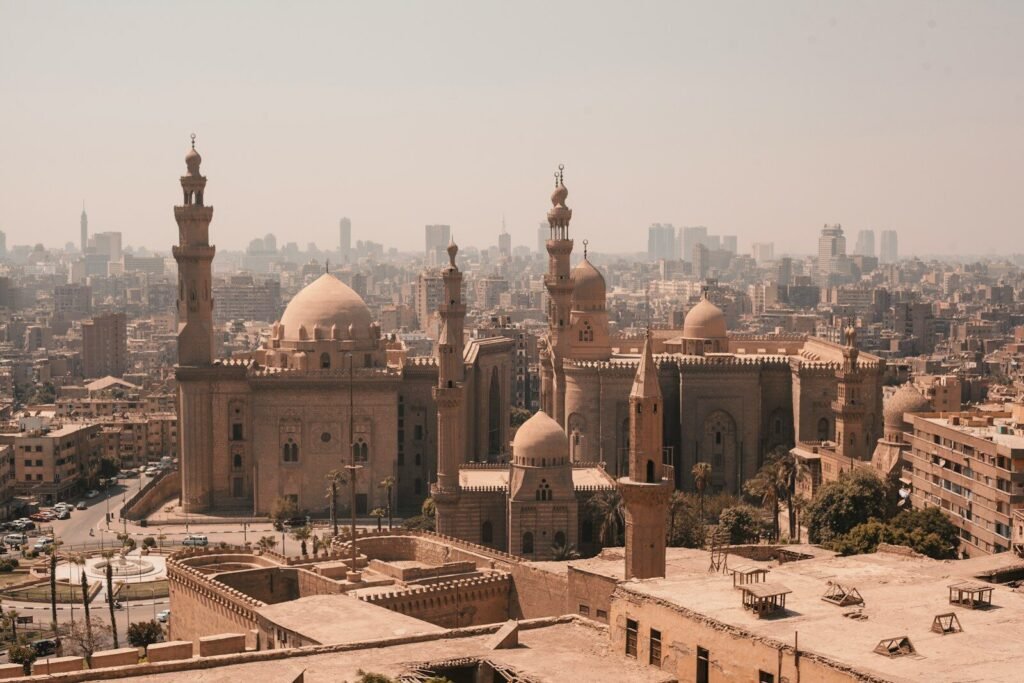
2. Egypt / Al-Azhar — the gold standard for Islamic studies
If your goal is Islamic studies — Arabic language, Quran memorization, fiqh, tafsir, hadith sciences, or Islamic history — there is no institution in the world that compares to Al-Azhar University in Cairo.
Al-Azhar’s unique position: Founded in 972 CE, Al-Azhar is the world’s foremost Sunni Islamic institution. It has been continuously producing scholars for over a thousand years. Its scholarly chain of transmission connects living students to the greatest scholars in Islamic history through an unbroken isnad. For Muslims pursuing serious Islamic knowledge — the kind that leads to scholarly credentials recognized across the Muslim world — Al-Azhar is not just the best option. For many fields of Islamic study, it is the only option.
International student program: Al-Azhar has an extensive program for international students at its Maahad (pre-university Arabic language program) and at the university level across its faculties of Islamic Studies, Arabic Language, Shariah and Law, and others. International students spend typically one to two years in the Arabic language program before entering degree programs taught in Arabic.
Cost: Al-Azhar’s programs for international students are among the most affordable in higher education — tuition is minimal, and Cairo’s overall cost of living means a student can manage on $400 to $700 per month depending on lifestyle. Egypt’s currency situation has made Cairo particularly affordable for students earning or supported in dollars or euros.
Other Cairo universities: The American University in Cairo (AUC) offers internationally recognized degrees in English, with higher tuition reflecting its American university model. Other Egyptian universities provide Arabic-medium instruction across various disciplines.
Trade-offs: The primary commitment is to Arabic. Students who are not already Arabic-literate should plan for a significant language investment before academic work begins. Cairo’s air quality and infrastructure challenges are real. The political environment requires monitoring. The academic intensity of Al-Azhar’s traditional program is considerable.
Best for: Muslims pursuing formal Islamic scholarship, Arabic language acquisition, or study in a city with the deepest Islamic scholarly tradition in the Sunni world.

3. Saudi Arabia — for Islamic studies and engineering
Saudi Arabia has invested enormously in its universities over the past two decades, transforming several institutions into world-class research universities with significant scholarship programs for international students.
Academic quality: King Abdullah University of Science and Technology (KAUST) is a world-class postgraduate research institution consistently ranked among the top universities in the Arab world, with significant scholarship programs. King Abdulaziz University, King Fahd University of Petroleum and Minerals, and several other institutions have strong international rankings in engineering, sciences, and medical fields.
Islamic significance: Studying in Saudi Arabia places you within proximity to Makkah and Madinah — an unparalleled spiritual opportunity. Students describe the experience of praying Jumu’ah at Masjid Al-Nabawi or performing Umrah during their studies as transformative in ways that no academic program can replicate. The Islamic scholarship available through interaction with scholars based in the Haramayn is significant.
Scholarship availability: Saudi Arabia offers generous scholarship programs through its universities for international students. The King Abdullah Scholarship Program and university-specific programs cover tuition, accommodation, and monthly stipends for qualifying students. Competition is significant but the financial support for accepted students is substantial.
English-language programs: KAUST operates entirely in English. Other universities have varying English-language program availability — many strong programs, particularly in STEM, are taught in English.
Trade-offs: Saudi Arabia’s social environment has liberalized significantly under Vision 2030 but remains conservative by Western standards. Cultural adjustment for students from Western backgrounds requires genuine preparation. The summer heat in Riyadh is extreme. Permanent residency or long-term stay is difficult for most non-Saudis.
Best for: Postgraduate students in STEM and engineering, Muslims who want proximity to the Haramayn as part of their student experience, those seeking scholarship funding for postgraduate programs.

4. United Arab Emirates — international education with Islamic infrastructure
The UAE has positioned itself as an international education hub, with branch campuses of major Western universities alongside its own emerging institutions — all within a Muslim-majority country with strong Islamic infrastructure.
Academic offerings: New York University Abu Dhabi, the Sorbonne Abu Dhabi, the University of Birmingham Dubai, Middlesex University Dubai, and dozens of other internationally recognized universities operate in the UAE. Students can earn degrees from globally recognized Western institutions while living in a Muslim-majority country. The UAE’s higher education regulatory body (KHDA in Dubai, CAA in Abu Dhabi) ensures academic standards.
Islamic student life: The UAE is approximately 76% Muslim by population. Mosques are everywhere — required by building code in residential areas. Halal food is the default across the country. The azaan is broadcast publicly. Islamic practice is accommodated structurally rather than as an exception.
Cost: UAE tuition and living costs are higher than other Muslim countries on this list — tuition at branch campuses can approach Western university costs, and living in Dubai or Abu Dhabi is expensive by regional standards. However, the combination of Western degree recognition and Islamic lifestyle infrastructure is unique.
Career opportunities: The UAE’s position as a global business hub means significant internship and networking opportunities during study, and post-graduation employment options that few other Muslim countries can match.
Best for: Students who want internationally recognized Western university degrees while living in a Muslim-majority country. Students whose post-graduation career goals align with the Gulf business environment. Those for whom the combination of academic credential and Islamic lifestyle is the priority.

5. Turkey — Islamic culture, European recognition, affordable
Turkey’s universities have improved significantly in international rankings over the past decade, and for Muslim students who want European-adjacent academic credentials in a Muslim-majority cultural environment, Turkey is one of the most interesting options available.
Academic quality: Boğaziçi University, Middle East Technical University (METU), and Koç University are Turkey’s most internationally recognized institutions, all in or near Istanbul. Several other Turkish universities have growing international reputations, particularly in engineering and social sciences.
Turkish Scholarships (Türkiye Bursları): Turkey’s government scholarship program for international students is one of the most generous in the Muslim world — covering full tuition, housing, monthly stipend, health insurance, and Turkish language instruction for accepted students. Competition is significant, but the financial support for accepted students is extraordinary.
Islamic life and culture: Istanbul in particular offers an extraordinary combination of Islamic cultural depth, Ottoman heritage, Sufi traditions, and the intellectual legacy of one of the greatest Islamic civilizations in history — with an accessible, modern urban lifestyle. Students describe Istanbul as one of the most spiritually rich environments available for Muslim student life.
European recognition: Turkish degree programs, particularly at the top universities, are increasingly recognized in European academic contexts. Graduates of Boğaziçi and METU find reasonable recognition of their credentials in European graduate school applications and employment markets.
Language: Programs at Turkey’s top universities are taught in English (Boğaziçi) or Turkish with English requirements (METU). The Turkish Scholarships program includes Turkish language instruction, and learning Turkish opens significant additional academic and professional opportunities.
Best for: Undergraduate and postgraduate students who want Islamic cultural environment, potential full scholarship funding, and European-adjacent academic credentials at significantly lower cost than Western universities.

6. Jordan — Arabic language immersion and Islamic studies
Jordan occupies a specific niche in the Muslim student world: a politically stable, safe, English-friendly Arab country with good universities and extraordinary Arabic language programs for non-native speakers.
University of Jordan and Jordan University of Science and Technology: These are Jordan’s most internationally recognized public universities, with strong programs in medicine, engineering, and Islamic studies. Tuition for international students is affordable by Western standards.
Arabic language programs: Jordan has a well-established Arabic language instruction ecosystem for non-native speakers, including the CASA Arabic program at the University of Jordan (a U.S. government-funded intensive program) and multiple other language centers. For students whose primary goal is Arabic language acquisition alongside Islamic studies, Amman provides an Arabic-speaking environment that is safer and more accessible for Westerners than Cairo.
Islamic infrastructure: Jordan is approximately 95% Muslim with strong Islamic practice and cultural identity. The proximity to significant Islamic heritage sites — the Prophet’s companions’ graves are in Jordan, as is Wadi Rum and the ancient city of Petra — makes the country spiritually rich beyond its formal institutional offerings.
Safety and accessibility: Jordan is consistently rated as one of the safest and most politically stable countries in the Arab world, with relatively liberal visa policies for Western students and a well-developed infrastructure for international visitors and students.
Best for: Students whose primary goal is Arabic language acquisition or Islamic studies in an Arabic-speaking environment, students who want the Middle Eastern experience with greater political stability than some alternatives, those interested in Jordan’s specific archaeological and heritage context.
Practical considerations for Muslim students studying abroad
Verify degree recognition before enrolling. Degrees from institutions in Malaysia, Turkey, and the UAE are generally well-recognized internationally. Degrees from Al-Azhar and Saudi institutions are widely recognized in the Muslim world but may require additional steps for recognition in Western countries or for certain professional qualifications. Research the specific recognition in your target post-graduation country before committing.
Apply for scholarships aggressively. The Turkish Scholarships, Malaysian MIS, Saudi university programs, and UAE university merit scholarships are significant and worth significant application effort. Many of them are undersubscribed by qualified Western Muslim applicants who don’t know they exist.
Research the specific city as much as the country. Cairo and Sharm El-Sheikh are completely different experiences. Kuala Lumpur and Kota Kinabalu are completely different experiences. The country-level analysis in this article is a starting point — the specific university and city determines your actual student experience.
Connect with Muslim student associations at target institutions. Every university on this list has active Muslim student communities. Reaching out before you enroll connects you with people who can give you honest, current, ground-level information about what student life is actually like — information no guidebook or article can provide.
Yala Media Group builds technology for the Muslim community where giving is structural, transparent, and effortless. Learn more at yalamediagroup.com.